


Vehicular Health Monitoring Digital Twin PoC
ICANIO built an AI-powered healthcare record digitization platform that cut manual data entry by 60% and improved patient record accessibility 4x.
HEALTHCARE AI . NLP VALIDATION . CLINICAL COMPLIANCE
Icanio built an AI medical text verification tool that uses NLP to automate the verification of clinical documentation and catch errors before they reach a patient record.
An AI medical text verification tool uses NLP to automate the verification of clinical documentation, catching terminology, dosage, and compliance errors before they reach a patient record. ICANIO built this medical text verification tool on Python, TensorFlow, and AWS, reaching a 99% accuracy rate while verifying clinical documents 70% faster than manual proofreading, and reducing compliance risk to effectively zero.
Manual verification of clinical documentation might catch most errors in a small practice, but it becomes a genuine liability once healthcare providers and researchers are processing complex terminology and clinical data at scale. ICANIO’s healthcare partner was facing exactly that risk: a high risk of clinical errors in manual text entry, difficulty identifying and validating complex medical terminology, inconsistent documentation styles across healthcare units, and no automated tools to detect non-compliant or risky medical phrasing.
ICANIO addressed this by developing an AI-Driven Medical Validation Engine rather than adding another manual review step. The objective was to integrate NLP models for real-time medical entity recognition, automate clinical terminology validation against standard medical databases, implement error detection for dosages, patient data, and medical codes, and build a centralized repository for standardized medical phrasing, all on a Python, TensorFlow, and AWS stack built for high-performance text processing. The result was a 99% accuracy rate and clinical documents verified 70% faster than manual proofreading.
Every one of those outcomes traces back to the same design decision: validating clinical text against a standardized reference in real time, at the point of entry, instead of relying on a human proofreader to catch errors after the fact.
“A single unnoticed dosage error in a patient record is not a documentation inconvenience, it is a clinical risk, and no proofreading schedule can catch it fast enough.”
Healthcare providers and researchers struggle with the high risk of inaccuracies in medical documentation. Manual verification of complex terminology and clinical data is prone to human error and operational delays.
High risk of clinical errors in manual text entry and verification meant even careful proofreaders could miss critical mistakes.
Difficulty in identifying and validating complex medical terminology slowed down reviewers who had to manually check every unfamiliar term.
Inconsistency in documentation styles across different healthcare units made records harder to compare and audit consistently.
Time-consuming manual cross-referencing of medical codes and data, compounded by slow proofreading, created operational bottlenecks across clinical reporting.
The lack of medical compliance automation to detect non-compliant or risky phrasing left compliance checks dependent entirely on manual review.
Icanio Technologies developed an AI-Driven Medical Validation Engine, utilizing advanced NLP models to automate the verification of clinical text and enhance data integrity. The solutions included:
01
Integrated NLP medical entity recognition for real-time analysis, identifying key clinical terms as documentation is entered.
02
Automated clinical terminology validation against standard medical databases, catching terminology errors before they reach a patient record.
03
Implemented error detection for dosages, patient data, and medical codes, targeting the highest-risk categories of documentation error.
04
Developed a secure interface for researchers to verify clinical documentation, giving them direct, controlled access to the validation engine.
05
Built a centralized repository for standardized medical phrasing and templates, resolving the inconsistency between healthcare units.
06
Leveraged a Python TensorFlow AWS stack for high-performance text processing, giving the engine the throughput to validate documentation at scale.
This medical text verification tool delivered outcomes across every dimension of the original documentation risk, converting a slow, error-prone manual process into an automated validation engine that catches errors before they reach a patient record.
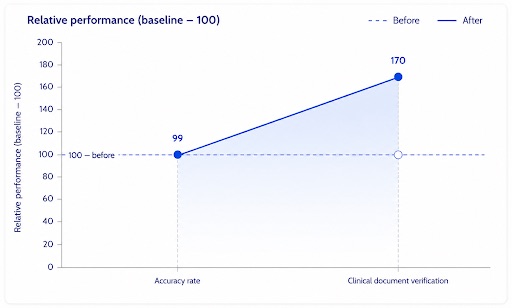
Performance improved through ICANIO’s AI-driven optimization, delivering measurable operational gains while maintaining financial accuracy.
Achieved in identifying and correcting medical terminology errors
Of clinical documents compared to manual proofreading processes
By automating detection of non-standard or unauthorized medical text
Ensuring consistent and reliable documentation across all healthcare records
By reducing the manual labor required for administrative medical audits
Minimizing the risk of clinical mishaps from documentation inaccuracies
01
Catching a dosage or terminology error after it has already been entered into a patient record is too late for the risk it represents. Validating clinical text in real time at the point of entry is what let this medical text verification tool prevent errors instead of just detecting them faster.
02
Inconsistent documentation styles across healthcare units were not a training problem, they were a missing shared reference problem. A centralized repository of standardized phrasing and templates gave every unit the same reference point, resolving the inconsistency structurally rather than through repeated correction.
03
Manual review can reduce compliance risk, but it cannot reliably eliminate it at scale. Automating the detection of non-standard or unauthorized medical text is what brought compliance risk down to effectively zero, a bar manual proofreading alone could not reach.
Manual verification of clinical documentation might catch most errors in a small practice, but for healthcare providers and researchers working with complex terminology at scale, it had become a source of clinical risk and operational delay. This engagement demonstrates that a single medical text verification tool can resolve accuracy, speed, and compliance gaps within one structured programme rather than three separate initiatives.
By integrating real-time medical entity recognition, automated terminology validation, and a centralized repository of standardized phrasing on a Python, TensorFlow, and AWS stack, ICANIO helped this partner reach a 99% accuracy rate, verify clinical documents 70% faster, and reduce compliance risk to effectively zero. The real-time validation, standardized phrasing repository, and high-performance processing delivered through this engagement are the foundation every future clinical document this team verifies will run on.
A medical text verification tool uses NLP to automate the verification of clinical documentation, catching terminology, dosage, and compliance errors before they reach a patient record. Clinical documentation needs one because manual verification cannot reliably catch every error at scale.
Real-time medical entity recognition identifies key clinical terms as documentation is entered, catching potential errors at the point of entry instead of during a later proofreading pass.
Automated clinical terminology validation checks documentation against standard medical databases, flagging terms that don't match recognized medical terminology before they reach a patient record.
Automating the detection of non-standard or unauthorized medical text catches compliance issues consistently, at a scale and reliability manual review alone could not sustain.
Python and TensorFlow provide the NLP modeling foundation, while AWS gives the engine the high-performance processing needed to validate clinical documentation in real time at scale.
A centralized repository of standardized medical phrasing and templates gives every healthcare unit the same reference point, resolving the inconsistency that previously varied from unit to unit.
From bold ideas to breakthrough execution – our case studies showcase how we transform business challenges into innovation-led success stories.
ICANIO built an AI-powered healthcare record digitization platform that cut manual data entry by 60% and improved patient record accessibility 4x.
ICANIO built an AI-powered healthcare record digitization platform that cut manual data entry by 60% and improved patient record accessibility 4x.

ICANIO built a digital healthcare platform integrating patient records, telemedicine, EHR, billing, wearables, and AI insights, reducing administrative workload by 40% and improvin

ICANIO built a healthcare backend engineering platform that delivered services 2x faster, reduced operational risk by 30%, and improved scalability, reliability, and integration.

ICANIO built an AI-powered healthcare record digitization platform that cut manual data entry by 60% and improved patient record accessibility 4x.

ICANIO built a multi-tenant LLM fine-tuning pipeline on Azure OpenAI with isolated client models, automated DeepEval quality gates, MLflow tracking, and complete training lineage.
Quick Links
Careers
Internship
Contact Sales
© 2025
Icanio - All rights reserved.
