

Vehicular Health Monitoring Digital Twin PoC
ICANIO built an AI-powered healthcare record digitization platform that cut manual data entry by 60% and improved patient record accessibility 4x.

15 Sep 2026
Software architecture has spent three decades perfecting the art of deterministic systems. A request enters, an API processes it, a service applies business rules, a database persists the result, and a response returns to the caller. This model scaled from monoliths to microservices, from on-premises to cloud-native, from synchronous APIs to event-driven platforms.
Each transition extended the same underlying principle: design the path a request follows, and the system will follow it reliably. Agentic AI architecture breaks this principle at the foundation. An AI agent does not follow a predefined path. It understands a goal, reasons about the problem, constructs a plan, invokes tools, observes outcomes, and re-plans when results diverge from expectations. The architect’s task shifts from designing request paths to designing decision boundaries, and that shift changes every layer of the enterprise technology stack.
ICANIO’s AgenticOps and Data and AI practices design agentic AI architecture programs, multi-agent systems, agent orchestration frameworks, AI observability platforms, and human-in-the-loop design patterns for enterprise clients across the USA, UK, Germany, Australia, and Malaysia. The this architecture principles, multi-agent systems patterns, and agent orchestration approaches in this guide reflect production agentic AI programs across financial services, healthcare, logistics, manufacturing, and enterprise software environments.
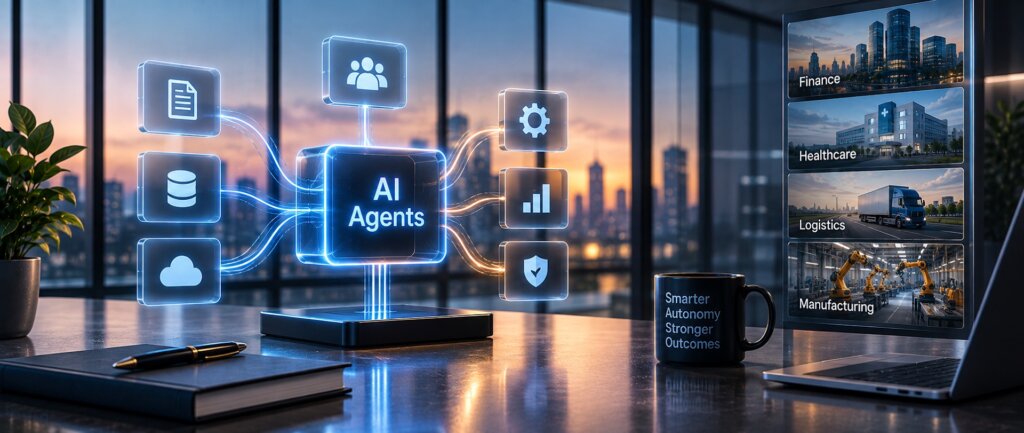
The architectural shift from request-driven to goal-driven systems is the defining characteristic of agentic AI architecture, and understanding it precisely is the prerequisite for every subsequent design decision. In a request-driven system, the architecture specifies exactly what happens at each step: which service receives a request, which business rules apply, which data is read or written, and what response is returned. The system has no latitude to deviate from the specified path. Correctness and predictability are guaranteed by the completeness of the specification.
In a goal-driven agentic AI architecture, the system is given an objective rather than a procedure. The AI agent reasons about how to achieve the objective, selects which tools to invoke, evaluates whether each action moved toward the goal, and re-plans when it did not. The architectural specification no longer describes every step.
It describes the boundaries within which the agent may reason and act, the tools the agent may use, the conditions under which it must escalate to human review, and the criteria by which success is measured. For ICANIO clients in the USA and UK building this architecture for enterprise workflows, this shift from specifying procedures to specifying boundaries is the most significant conceptual change required from architecture and engineering teams. The skill of constraint design, defining what a system is allowed to decide and do rather than exactly what it will do, becomes as important as service design in the this architecture discipline.
In traditional enterprise architecture, APIs enable communication between services and applications. In agentic AI architecture, APIs become tools available to AI agents, and this reclassification introduces governance requirements that standard API design has never needed to address. An insurance AI agent with access to tools for retrieving customer information, validating policies, checking eligibility, calculating premiums, creating claims, generating documents, and sending notifications is not simply calling APIs. It is making autonomous decisions about which of those actions to take, in what sequence, and based on what information, without a human reviewing each decision.
This capability creates an architectural question that agentic AI architecture must answer explicitly: what should an AI agent be allowed to do? The answer cannot be “whatever the API permits,” because API permissions were designed for authenticated human users or deterministic service integrations, not for autonomous agents making goal-directed decisions at scale.
this architecture requires tool-level authorisation that distinguishes what an agent may access from what it may execute, least-privilege access policies that limit agent tool scope to what the specific task requires, input validation that prevents prompt injection attacks from hijacking agent actions, rate limiting that bounds the volume of agent-initiated operations, human approval gates for high-risk actions such as financial transactions or data deletions, and compensation mechanisms that can roll back agent actions when a multi-step workflow fails partway through. For ICANIO clients in Germany and Australia implementing this architecture for regulated industry workflows, these governance requirements are not optional safeguards.
They are architectural requirements that must be specified before any agent tool integration is built.
Agent orchestration is the architectural layer that coordinates how multiple AI agents collaborate to achieve goals that exceed the capability of any single agent. As agentic AI architecture programs mature, the initial single-agent deployment typically reveals that complex enterprise workflows require specialised agents working in concert: a customer-facing agent that gathers requirements, a policy agent that interprets business rules, a compliance agent that validates regulatory constraints, a document agent that generates outputs, and an orchestrator that coordinates the sequence and resolves conflicts between specialist agents. This is the multi-agent systems architecture that increasingly characterises production agentic AI deployments.
Agent orchestration design must address three challenges that do not exist in single-agent deployments. The first is inter-agent communication: how agents share context, pass results, and signal completion or failure to the orchestrator. The second is conflict resolution: what happens when two agents produce incompatible outputs or when one agent’s action invalidates another’s assumption. The third is failure containment: how the orchestrator detects that a specialist agent has failed or produced an unreliable output and determines whether to retry, re-route, escalate, or roll back.
For ICANIO clients in the UK and Malaysia building multi-agent systems for enterprise operations, agent orchestration architecture is where the design complexity of agentic AI systems is concentrated. A well-designed agent orchestration layer produces a coherent, governable multi-agent system. A poorly designed one produces an uncontrolled network of autonomous components that is difficult to audit, debug, or correct. ICANIO treats agent orchestration design as a primary architectural deliverable, not an implementation detail, in every such engagement for enterprise clients in the USA, UK, Germany, Australia, and Malaysia.
Multi-agent systems introduce a category of state management that traditional application architecture has not needed to address: agent memory. A single-request system maintains state for the duration of the request and discards it on completion. Multi-agent systems require persistent context that survives across interactions, informs subsequent agent decisions, and must be managed with the same rigour applied to operational data.
An enterprise AI agent operating across an extended workflow may need access to conversation context from earlier in the same session, customer history from previous interactions, business knowledge from organisational knowledge bases, the history of actions taken so far in the current task, user preferences accumulated across interactions, the current state of the task in progress, relevant documents retrieved during earlier steps, and applicable organisational policies. Each of these memory types has different persistence requirements, different access control needs, and different freshness constraints.
Conversation context is session-scoped. Customer history may be retained indefinitely under data governance policies. Task state must be durable enough to survive agent restarts. For ICANIO clients in the USA and Australia designing multi-agent systems for enterprise customer service and operations platforms, memory architecture is a first-class design concern that determines both the functional capability of the agentic system and its compliance with data privacy regulations. The question of what an agent should remember, for how long, and who may access that memory is a product and security architecture decision, not a database implementation choice.
Human-in-the-loop design is the architectural pattern that determines where human judgment remains essential in agentic AI workflows and how the system routes decisions to human reviewers when required. The introduction of AI agents into enterprise workflows does not eliminate human involvement. It restructures it, moving humans from executing routine steps to providing judgment at the decision points where the consequences of error are too significant for autonomous action.
A well-designed human-in-the-loop design framework creates a spectrum of autonomy that maps action types to appropriate oversight levels. Low-risk, high-frequency actions with well-understood outcomes are executed autonomously by the agent with no human review. Medium-risk actions that affect significant assets or customer commitments are executed by the agent but logged immediately for human audit and subject to override. High-risk actions that involve financial authorisation, regulatory reporting, or irreversible operational changes are proposed by the agent and held for explicit human approval before execution.
The human-in-the-loop design specification defines the criteria that classify each action type, the approval routing logic that identifies the correct human reviewer, and the timeout and escalation behaviour when approval is not received within the required window. For ICANIO clients in Germany and the UK deploying agentic AI architecture in regulated financial services and healthcare environments, human-in-the-loop design is a compliance requirement as well as an engineering practice. Regulators in both markets expect documented evidence that autonomous AI systems have defined human oversight mechanisms for consequential decisions.
AI observability is the architectural capability that allows engineering and operations teams to understand why an AI agent took a specific action, not just whether the action succeeded technically. Traditional observability infrastructure covers logs, metrics, distributed traces, error rates, and infrastructure health, which are sufficient for understanding why a deterministic service failed. They are insufficient for understanding why an AI agent chose one tool over another, what context influenced its reasoning, or where in a multi-step workflow its plan diverged from the expected path.
AI observability in agentic systems requires capturing the decision trace alongside the execution trace: the goal the agent was pursuing, the plan it constructed, the context and knowledge it retrieved, the tools it considered and selected, the reasoning it applied to interpret tool outputs, and the evaluation it performed to determine whether the action moved toward the goal. This AI observability data transforms agent debugging from speculation to evidence-based investigation.
When a multi-agent workflow produces an incorrect outcome, AI observability allows the engineering team to identify precisely which agent, at which step, with which context, made the decision that led to the error. For ICANIO clients in the USA and Australia operating production agentic AI systems at scale, AI observability infrastructure is not a monitoring add-on. It is the mechanism that makes agentic AI architecture governable, debuggable, and continuously improvable. Agent tracing and evaluation are first-class capabilities in every production this architecture that ICANIO designs for enterprise clients across all supported geographies.
Security in agentic AI architecture extends well beyond the authentication and authorisation model that protects traditional APIs. Standard API security asks whether a user is permitted to call a specific endpoint. Agentic AI security must answer a different and more complex set of questions: who authorised the agent to act on a user’s behalf, what scope of tools is the agent permitted to invoke in this context, which data sources may the agent retrieve from, which actions require additional approval before execution, can the agent’s reasoning be manipulated through adversarial inputs in its context, and is there a complete audit trail documenting why each agent action occurred.
The security model for agentic AI architecture therefore evolves from a user-to-API authorisation model to an agent identity and policy enforcement model. Every agent must have a defined identity, a documented tool scope, and a policy specification that governs what it may access and execute.
Agentic AI architecture is the design discipline for systems where AI agents autonomously reason about goals, construct plans, invoke tools, observe outcomes, and re-plan when needed, rather than following predefined request-response procedures. It requires specifying decision boundaries, tool governance, memory management, human-in-the-loop design patterns, AI observability infrastructure, and agent security policies as primary architectural concerns alongside service design and data architecture.
Agent orchestration coordinates multiple specialised AI agents through a central orchestrator that manages task routing, inter-agent communication, conflict resolution, and failure handling. Each specialist agent handles a specific domain such as customer interaction, policy validation, compliance checking, or document generation. The orchestrator sequences agent activities, passes context between agents, and determines when to retry, escalate, or roll back when an agent produces an error or unreliable output.
Human-in-the-loop design is the architectural pattern that defines where human judgment is required in agentic AI workflows. It creates a spectrum of autonomy where low-risk actions are executed automatically, medium-risk actions are executed with audit logging, and high-risk actions require explicit human approval before the agent proceeds. Human-in-the-loop design specifies the criteria for each risk level, the routing logic for approvals, and the escalation behaviour when approvals are delayed.
AI observability captures the decision trace of an AI agent alongside the execution trace, recording the goal, plan, context, tool selections, reasoning, and outcome evaluation that drove each action. Standard monitoring answers why a service call failed technically. AI observability answers why an agent chose a specific tool, what information influenced its decision, and where a multi-agent workflow diverged from the expected path. It is the mechanism that makes agentic AI systems auditable and debuggable in production.
Agentic AI architecture introduces security risks without equivalents in traditional systems: prompt injection, where adversarial content in an agent's context manipulates its reasoning to take unauthorised actions; agent identity spoofing, where an attacker impersonates an authorised agent to invoke privileged tools; and scope creep, where an agent with broad tool access takes actions outside its intended operating boundaries. Mitigation requires agent identity policies, tool-level authorisation, input validation, and AI observability infrastructure that provides a complete audit trail of agent actions.

ICANIO’s engineering team offers a no-obligation discovery call to look at what you’re dealing with, give you a straight read on the technical feasibility, and outline a delivery plan suited to your organisation’s scale, compliance environment, and budget.
From bold ideas to breakthrough execution our case studies showcase how we transform business challenges into innovation-led success stories.
ICANIO built an AI-powered healthcare record digitization platform that cut manual data entry by 60% and improved patient record accessibility 4x.
ICANIO built an AI-powered healthcare record digitization platform that cut manual data entry by 60% and improved patient record accessibility 4x.

ICANIO built a digital healthcare platform integrating patient records, telemedicine, EHR, billing, wearables, and AI insights, reducing administrative workload by 40% and improvin

ICANIO built a healthcare backend engineering platform that delivered services 2x faster, reduced operational risk by 30%, and improved scalability, reliability, and integration.

ICANIO built an AI-powered healthcare record digitization platform that cut manual data entry by 60% and improved patient record accessibility 4x.

ICANIO built a multi-tenant LLM fine-tuning pipeline on Azure OpenAI with isolated client models, automated DeepEval quality gates, MLflow tracking, and complete training lineage.
Quick Links
Careers
Internship
Contact Sales
© 2025
Icanio - All rights reserved.
