


Vehicular Health Monitoring Digital Twin PoC
ICANIO built an AI-powered healthcare record digitization platform that cut manual data entry by 60% and improved patient record accessibility 4x.
REACT 18 . FRONTEND MODERNIZATION . DEVELOPER PRODUCTIVITY
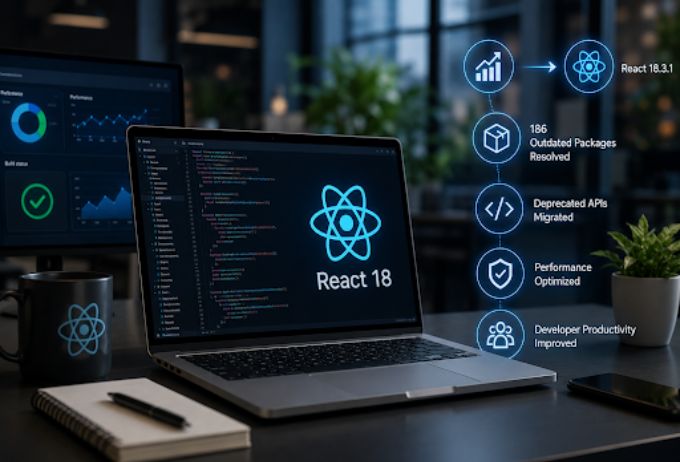
This React application modernization upgraded a legacy frontend from React 16.3.1 to 18.3.1, resolving 186 outdated packages, migrating deprecated APIs, and refactoring UI components for React 18 compatibility.
React application modernization upgrades a legacy React version, resolves outdated dependencies, and migrates deprecated APIs to restore compatibility, performance, and developer productivity. ICANIO completed this React application modernization by upgrading from React 16.3.1 to 18.3.1 and resolving 186 outdated packages, tripling developer productivity and optimizing application performance by 40%.
Modernizing the frontend required upgrading React from 16.3.1 to 18.3.1 while resolving numerous outdated dependencies, deprecated APIs, and ensuring UI stability, performance, and compatibility. ICANIO’s partner was facing exactly that gap: a legacy React version that created compatibility issues with modern libraries, 186 outdated packages causing dependency conflicts and build instability, deprecated APIs like useHistory and Switch requiring migration, and Storybook and UI components incompatible with React 18 architecture.
ICANIO addressed this by executing a structured React modernization rather than a risky big-bang rewrite. The objective was to incrementally upgrade React from 16.3.1 to 18.3.1 safely, replace deprecated APIs using React Router v6 hooks, refactor UI components and Storybook for React 18 compatibility, and implement regression testing and monitoring to ensure stability, scalability, and performance throughout the migration.
The result was a modernized tech stack architecture foundation with a future-ready system architecture, improved code maintainability, and a seamless user experience delivery platform, alongside a threefold increase in developer productivity and a 40% optimization in application performance efficiency.
“186 outdated packages is not a backlog item, it is 186 separate reasons the next feature release could break in production.”
Modernizing the frontend required upgrading React from 16.3.1 to 18.3.1 while resolving numerous outdated dependencies, deprecated APIs, and ensuring UI stability, performance, and compatibility.
The legacy React version created compatibility issues with modern libraries, blocking adoption of current frontend tooling.
186 outdated packages caused dependency conflicts and build instability, turning routine builds into unpredictable failures.
Deprecated APIs like useHistory and Switch required migration before the application could run on React 18 at all.
Storybook and UI components incompatible with React 18 architecture threatened to break the team’s component development workflow.
Migration risked performance issues and application breakages, and ensuring a seamless user experience throughout the upgrade was equally critical.
Icanio executed a structured React modernization by upgrading dependencies, refactoring deprecated APIs, updating UI components and Storybook, and implementing testing and monitoring to ensure stability, scalability, and performance. The solutions included:
01
Incrementally upgraded React from 16.3.1 to 18.3.1 safely, avoiding a single high-risk cutover in favor of staged, verifiable steps.
02
Replaced deprecated APIs using React Router v6 hooks, retiring useHistory and Switch in favor of current routing patterns.
03
Refactored UI components for React 18 compatibility, resolving the rendering and lifecycle changes the new version introduced.
04
Upgraded Storybook to support the updated component architecture, keeping the component development workflow intact after the upgrade.
05
Implemented regression testing for stable feature functionality, catching breakages before they reached production.
06
Applied monitoring and error handling for runtime stability, giving the team visibility into how the modernized frontend performed live.
This React application modernization delivered outcomes across every dimension of the original legacy-frontend problem, converting an unstable, conflict-prone codebase into a modern, maintainable, and high-performing platform.

Performance improved through ICANIO’s AI-driven optimization, delivering measurable operational gains while maintaining financial accuracy.
Stack architecture foundation
System architecture scalability
Code maintainability and stability
Experience delivery platform
Developer productivity levels
Application performance efficiency
01
Jumping from React 16.3.1 to 18.3.1 in one step across 186 outdated packages would have made root-causing any single failure nearly impossible. Upgrading incrementally and safely is what kept the migration debuggable at every stage.
02
Leaving useHistory and Switch in place until after upgrading React would have meant a broken application the moment the new version shipped. Migrating to React Router v6 hooks first is what made the version bump itself uneventful.
03
Storybook and UI components incompatible with React 18 would have quietly broken the team’s own development workflow even after the application itself worked. Upgrading tooling in step with the framework is what kept productivity gains real instead of theoretical.
A React 16.3.1 frontend might have been workable while its dependencies stayed current, but with 186 outdated packages and deprecated APIs accumulating, it had become a real risk to every future release. This engagement demonstrates that a single React application modernization can resolve compatibility, stability, and productivity gaps within one structured programme rather than three separate initiatives.
By completing a React 18 migration, adopting React Router v6, and upgrading Storybook alongside better frontend dependency management, ICANIO helped this partner triple developer productivity and optimize application performance by 40%. The modernized architecture and regression-tested stability delivered through this engagement are the foundation every future feature this frontend ships will run on.
React application modernization upgrades a legacy React version and resolves outdated dependencies, needed here because React 16.3.1 created compatibility issues and 186 outdated packages caused dependency conflicts and build instability.
The React 18 migration involved resolving 186 outdated packages, migrating deprecated APIs, refactoring UI components, and upgrading Storybook, not just bumping the version number in package.json.
React Router v6 replaced useHistory and Switch because those APIs were deprecated and incompatible with the routing patterns React 18 applications need going forward.
The Storybook upgrade kept the component development workflow intact by updating it to support the same architecture the refactored UI components now used under React 18.
Frontend dependency management resolved the 186 outdated packages that were causing conflicts, establishing a cleaner dependency baseline that reduces the risk of similar conflicts recurring.
Developer productivity increased threefold after this React application modernization, alongside a 40% optimization in application performance efficiency.
From bold ideas to breakthrough execution – our case studies showcase how we transform business challenges into innovation-led success stories.
ICANIO built an AI-powered healthcare record digitization platform that cut manual data entry by 60% and improved patient record accessibility 4x.
ICANIO built an AI-powered healthcare record digitization platform that cut manual data entry by 60% and improved patient record accessibility 4x.

ICANIO built a digital healthcare platform integrating patient records, telemedicine, EHR, billing, wearables, and AI insights, reducing administrative workload by 40% and improvin

ICANIO built a healthcare backend engineering platform that delivered services 2x faster, reduced operational risk by 30%, and improved scalability, reliability, and integration.
ICANIO built an AI-powered healthcare record digitization platform that cut manual data entry by 60% and improved patient record accessibility 4x.

ICANIO built a multi-tenant LLM fine-tuning pipeline on Azure OpenAI with isolated client models, automated DeepEval quality gates, MLflow tracking, and complete training lineage.
Quick Links
Careers
Internship
Contact Sales
© 2025
Icanio - All rights reserved.
