


Vehicular Health Monitoring Digital Twin PoC
ICANIO built an AI-powered healthcare record digitization platform that cut manual data entry by 60% and improved patient record accessibility 4x.
AWS MIGRATION . INFRASTRUCTURE AS CODE . HIGH AVAILABILITY
This JIRA Data Center AWS migration moved the client off costly per-user JIRA Cloud licensing onto a self-hosted, high-availability AWS environment.
A self-hosted JIRA Data Center AWS deployment moves an organization off per-user JIRA Cloud licensing onto infrastructure it owns and controls, using Infrastructure as Code to provision a highly available, secure AWS environment. ICANIO executed this JIRA Data Center AWS migration for a partner facing escalating cloud licensing costs, delivering a self-hosted environment built on CloudFormation, Multi-AZ RDS, and Application Load Balancers that cut licensing costs by 50%, achieved 99.9% uptime, and made infrastructure scaling 3x faster.
Per-user JIRA Cloud licensing scales in the worst possible direction for a growing engineering organization: the more the team grows, the more the platform costs, with no corresponding increase in control. ICANIO’s partner was feeling that pressure directly, escalating licensing costs were hindering operational budgeting, and the organization had limited control over its own application environment and data residency. On top of that, it needed high availability across diverse geographical regions, was carrying data-loss risk from fragmented backup strategies, and had run into scaling limitations within its existing proprietary cloud environment.
ICANIO addressed this with a JIRA Data Center AWS migration built around Infrastructure as Code rather than a manual lift-and-shift. The objective was to provision the entire environment through AWS CloudFormation automation, deliver high availability through an Application Load Balancer and Multi-AZ RDS, centralize shared storage across node clusters using Amazon EFS, and harden the security perimeter with AWS WAF and VPC isolation. The result was a self-hosted environment that costs 50% less to license, runs at 99.9% uptime, and scales 3x faster than the proprietary cloud environment it replaced.
Every outcome traces back to the same architectural choice: owning the infrastructure through Infrastructure as Code instead of renting it per user, so cost, control, and availability improved together rather than being traded off against each other.
“Per-user licensing does not just cost more as a team grows, it caps how much control that team ever has over its own environment.”
Our partners faced escalating operational costs due to JIRA Cloud’s per-user licensing model. To regain financial control and data sovereignty, they needed to overcome several infrastructure challenges.
Escalating JIRA Cloud licensing costs hindered operational budgeting, since per-user pricing meant costs kept rising in step with every new engineering hire.
Limited control over the application environment and data residency left the organization unable to dictate where its own data lived or how the platform was configured.
The need for high availability across diverse geographical regions was not met by the existing setup, leaving the organization exposed to regional outages.
Fragmented backup strategies increased the risk of data loss, with no single, consistent recovery process across the environment.
Complex security requirements necessitated a custom VPC architecture that the existing proprietary cloud environment could not provide.
Icanio Technologies architected a High-Availability JIRA Data Center on AWS, utilizing Infrastructure as Code (IaC) to ensure a secure, scalable, and cost-effective deployment. The solutions included:
01
Automated infrastructure provisioning via AWS CloudFormation templates replaced manual setup with a repeatable, version-controlled JIRA Data Center AWS deployment.
02
High availability via an Application Load Balancer and Multi-AZ RDS keeps the platform running across zones, closing the regional-outage gap the old environment had.
03
Centralized shared storage using Amazon EFS for node clusters gives every node in the JIRA Data Center AWS deployment consistent access to the same file system.
04
Real-time monitoring and logging integrated through AWS CloudWatch gives the team centralized visibility across the entire self-hosted environment.
05
Automated recovery and protection using native AWS Backup tools replaced the fragmented backup strategies that had previously put data at risk.
06
An enhanced security perimeter using AWS WAF and VPC isolation meets the complex security requirements that a shared, proprietary cloud environment could not.
The JIRA Data Center AWS migration delivered outcomes across every dimension of the client’s original constraints, converting a costly, hard-to-control licensing model into a self-hosted environment that costs less, runs more reliably, and puts infrastructure decisions back in the client’s hands.
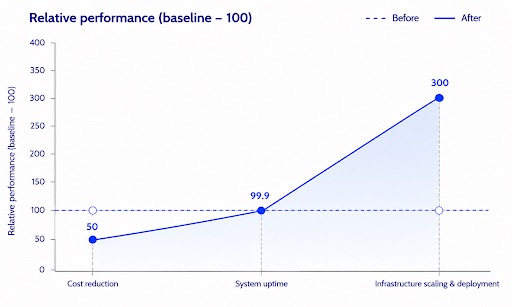
Performance improved through ICANIO’s AI-driven optimization, delivering measurable operational gains while maintaining financial accuracy.
By eliminating expensive cloud licensing
Via Multi-AZ high availability architecture
In automated infrastructure scaling and deployment
Via 3-click IaC environment provisioning
Via native AWS WAF and VPC
Via integrated CloudWatch performance monitoring
01
Per-user cloud licensing feels convenient right up until the organization has grown enough for the recurring cost to outweigh the convenience. Moving to a self-hosted JIRA Data Center AWS deployment does not eliminate infrastructure responsibility, it shifts it, but Infrastructure as Code is what makes that shift affordable rather than a new operational burden.
02
A self-hosted environment only matches or beats a managed cloud’s uptime if it is built with the same resilience assumptions. The Application Load Balancer and Multi-AZ RDS pairing is what let this migration hit 99.9% uptime instead of introducing new availability risk.
03
Fragmented backup strategies and ad hoc security were part of the original problem, not something to defer until after the AWS migration was live. Building AWS Backup and WAF/VPC isolation into the CloudFormation templates from day one meant the new environment was more secure and more resilient than the one it replaced, immediately.
Per-user JIRA Cloud licensing might be the simplest option for a small team, but for an organization scaling across regions with strict security and data residency requirements, it had become the primary constraint on the business. This engagement demonstrates that a self-hosted JIRA Data Center AWS migration can resolve cost, availability, and control challenges within a single Infrastructure as Code AWS programme rather than three separate initiatives.
By provisioning the environment through AWS CloudFormation and pairing an Application Load Balancer with Multi-AZ RDS, Amazon EFS, AWS Backup, and WAF/VPC isolation, ICANIO helped this partner cut licensing costs by 50%, reach 99.9% uptime, and scale infrastructure 3x faster than before. The Infrastructure as Code, centralized monitoring, and hardened security perimeter delivered through this engagement are the foundation every future environment this team provisions will run on.
A JIRA Data Center AWS migration moves an organization from per-user JIRA Cloud licensing to a self-hosted deployment it owns and controls on AWS. Organizations choose a self-hosted JIRA migration when licensing costs scale faster than their budget, and when they need more control over data residency and environment configuration than a shared cloud platform allows.
AWS CloudFormation defines the entire JIRA Data Center AWS environment as version-controlled templates rather than a manual setup checklist, so the infrastructure can be provisioned, updated, and audited consistently instead of depending on one-off manual configuration.
An Application Load Balancer distributes traffic across healthy nodes while Multi-AZ RDS keeps the database available even if an entire availability zone fails, the combination that let this migration reach 99.9% uptime.
Amazon EFS provides centralized shared storage that every node in the JIRA Data Center AWS cluster can access consistently, which is required for a multi-node deployment to behave as a single coherent application.
No, in this engagement it delivered stronger security. Building AWS WAF and VPC isolation into the CloudFormation templates from the start gave the client full security control over its perimeter, control that a shared, proprietary cloud environment could not offer.
Infrastructure scaling and deployment became 3x faster, driven by automated, 3-click Infrastructure as Code provisioning through AWS CloudFormation, replacing what had previously been a manual, slower scaling process.
From bold ideas to breakthrough execution – our case studies showcase how we transform business challenges into innovation-led success stories.
ICANIO built an AI-powered healthcare record digitization platform that cut manual data entry by 60% and improved patient record accessibility 4x.
ICANIO built an AI-powered healthcare record digitization platform that cut manual data entry by 60% and improved patient record accessibility 4x.

ICANIO built a digital healthcare platform integrating patient records, telemedicine, EHR, billing, wearables, and AI insights, reducing administrative workload by 40% and improvin

ICANIO built a healthcare backend engineering platform that delivered services 2x faster, reduced operational risk by 30%, and improved scalability, reliability, and integration.

ICANIO built an AI-powered healthcare record digitization platform that cut manual data entry by 60% and improved patient record accessibility 4x.

ICANIO built a multi-tenant LLM fine-tuning pipeline on Azure OpenAI with isolated client models, automated DeepEval quality gates, MLflow tracking, and complete training lineage.
Quick Links
Careers
Internship
Contact Sales
© 2025
Icanio - All rights reserved.
