

Vehicular Health Monitoring Digital Twin PoC
ICANIO built an AI-powered healthcare record digitization platform that cut manual data entry by 60% and improved patient record accessibility 4x.
DEVOPS AUTOMATION . CI/CD PIPELINE . FINANCIAL SERVICES CLOUD
ICANIO built a DevOps automation platform for a financial services partner to replace fragmented delivery cycles with standardized, zero-manual-deployment pipelines.
A DevOps automation platform for financial services unifies CI/CD pipelines, infrastructure provisioning, and observability into a single standardized system, replacing the fragmented, manual delivery cycles that slow release velocity and create compliance risk. ICANIO built this DevOps automation platform for a financial services partner, unifying CI/CD through Jenkins and GitHub Actions, automating infrastructure provisioning with Terraform and CloudFormation, and centralizing observability across Prometheus, Grafana, and the ELK Stack, delivering 70% faster deployments, a 30% cut in cloud costs, and 99.9% uptime.
Fragmented delivery cycles are a common failure mode in financial services engineering, but they carry a heavier cost than in most industries: every manual handoff between disconnected tools is also a potential compliance gap. ICANIO’s financial services partner was running exactly this kind of environment, disconnected tooling that limited visibility, manual infrastructure provisioning that introduced delay and error, and fragmented governance models that created security and compliance vulnerabilities alongside rising operational costs from managing diverse, unoptimized environments.
ICANIO addressed this by building a single DevOps automation platform rather than patching the existing toolchain. The objective was to unify CI/CD delivery through Jenkins and GitHub Actions, replace manual infrastructure provisioning with Infrastructure as Code automation via Terraform and CloudFormation templates, and centralize observability across Prometheus, Grafana, and the ELK Stack, with automated security scanning and containerized orchestration built into the same pipeline. The result was a platform that deploys 70% faster, runs at 30% lower cloud cost, and sustains 99.9% uptime through proactive, automated alerting.
Every one of those outcomes traces back to the same design decision: standardizing on one DevOps automation platform instead of layering point solutions onto an already fragmented toolchain, so speed, cost, and governance improved together rather than trading off against each other.
“Disconnected tools do not just slow a release, in financial services they turn every manual handoff into an unaudited gap in governance.”
Our financial services partner struggled with fragmented delivery cycles that compromised both speed and security. The resulting operational costs from managing diverse, unoptimized environments compounded every bottleneck below.
Disconnected tools caused operational inefficiency and poor visibility across teams, leaving no single source of truth for the health of the delivery pipeline.
Manual infrastructure provisioning led to deployment delays and errors, since every new environment depended on a team member repeating error-prone manual steps.
The lack of standardized pipelines hindered rapid software delivery cycles, with each team maintaining its own inconsistent release process.
Fragmented governance models created security and compliance vulnerabilities, a direct risk for a platform operating under financial services oversight.
The absence of centralized monitoring delayed critical incident response times, leaving the team without the real-time visibility needed to catch issues before they escalated.
Icanio Technologies architected a unified DevOps automation platform that standardizes deployments and infrastructure management through high-performance automation. The solutions included:
01
Unified CI/CD pipelines using Jenkins and GitHub Actions replaced the patchwork of disconnected delivery tools with a single standardized release process.
02
Automated infrastructure provisioning via Terraform and CloudFormation templates turned manual, error-prone environment setup into repeatable, auditable deployments.
03
Centralized observability with Prometheus, Grafana, and the ELK Stack gave the team a single centralized observability platform across every environment.
04
Automated security scanning and governance were built directly within the pipeline, closing the compliance gaps the previous fragmented toolchain had left open.
05
Containerized workload orchestration delivered consistent performance across environments, removing the configuration drift that had caused unpredictable incidents.
06
Proactive alerting systems for real-time infrastructure health monitoring let the team catch and resolve issues before they affected customers.
The DevOps automation platform delivered outcomes across every dimension of the client’s original bottlenecks, converting a fragmented, manual delivery process into a standardized platform that ships faster, costs less to run, and gives financial services stakeholders the governance visibility they require.
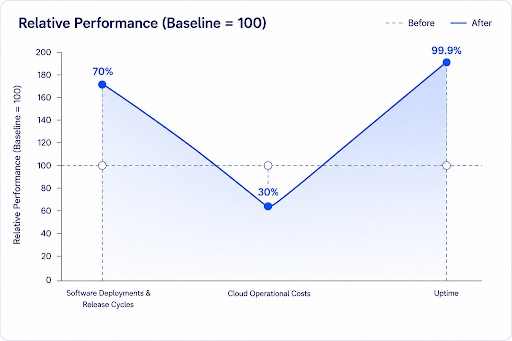
Performance improved through ICANIO’s AI-driven optimization, delivering measurable operational gains while maintaining financial accuracy.
In software deployments and release cycles
In overall cloud operational costs
Via proactive monitoring and alerts
Via 3-click IaC and pipeline triggers
Through integrated automated security scans
Via centralized Grafana and ELK dashboards
01
Faster deployments and stronger governance are often treated as competing goals, but in this engagement they came from the same change: replacing a fragmented toolchain with one standardized DevOps automation platform. Once CI/CD, provisioning, and observability all ran through the same pipeline, automated security scanning and consistent environments became the natural byproduct of speed, not a separate initiative competing for the same engineering time.
02
Manual infrastructure provisioning was not just slow, it was the direct source of the deployment errors the team was troubleshooting. Replacing it with Terraform and CloudFormation templates did not just speed up provisioning, it removed the manual step that had been generating the errors in the first place.
03
The absence of centralized monitoring meant the team only found out about problems after customers did. Consolidating Prometheus, Grafana, and the ELK Stack into one observability layer gave the team the proactive alerting needed to resolve issues before they escalated into customer-facing incidents.
Fragmented delivery cycles might be tolerable for a low-stakes internal tool, but for a financial services partner operating under strict governance expectations, disconnected tooling and manual provisioning had become a genuine business risk. This engagement demonstrates that a single, unified DevOps automation platform can resolve speed, cost, and governance gaps within one structured programme rather than three separate initiatives.
By unifying CI/CD through Jenkins and GitHub Actions, automating infrastructure provisioning with CI/CD pipeline automation and Infrastructure as Code, and centralizing observability across Prometheus, Grafana, and the ELK Stack, ICANIO helped this partner ship 70% faster, cut cloud costs by 30%, and sustain 99.9% uptime, all while strengthening governance through automated security scanning built into the same pipeline. The standardized CI/CD, Infrastructure as Code, and centralized observability delivered through this engagement are the foundation every future release and incident response on this platform will run on.
A DevOps automation platform unifies CI/CD, infrastructure provisioning, and observability into one standardized system, replacing the fragmented, manual delivery process that slows releases and creates compliance risk. For a financial services partner, it matters because disconnected tooling and manual provisioning are not just inefficient, they are governance gaps regulators and auditors will eventually ask about.
Running CI/CD through a single Jenkins and GitHub Actions pipeline replaced a patchwork of inconsistent, team-specific release processes with one standardized, auditable workflow, the change that unlocked the 70% faster deployment cycle in this engagement.
Terraform and CloudFormation define every environment as version-controlled code rather than a manual checklist, removing the human step that was the direct source of the client's original provisioning errors and delays.
Consolidating Prometheus, Grafana, and the ELK Stack into a single observability layer gave the team centralized, real-time visibility and proactive alerting, replacing the fragmented monitoring that had previously delayed incident response.
No, in this engagement it did the opposite. Building automated security scanning directly into the CI/CD pipeline meant governance checks ran alongside every deployment rather than as a separate manual gate, so releases got faster and more secure at the same time.
Standardizing on containerized workload orchestration and automated infrastructure provisioning eliminated the diverse, unoptimized environments the team had previously been maintaining manually, which is what drove the 30% reduction in cloud operational costs.
From bold ideas to breakthrough execution – our case studies showcase how we transform business challenges into innovation-led success stories.
ICANIO built an AI-powered healthcare record digitization platform that cut manual data entry by 60% and improved patient record accessibility 4x.
ICANIO built an AI-powered healthcare record digitization platform that cut manual data entry by 60% and improved patient record accessibility 4x.

ICANIO built a digital healthcare platform integrating patient records, telemedicine, EHR, billing, wearables, and AI insights, reducing administrative workload by 40% and improvin

ICANIO built a healthcare backend engineering platform that delivered services 2x faster, reduced operational risk by 30%, and improved scalability, reliability, and integration.

ICANIO built an AI-powered healthcare record digitization platform that cut manual data entry by 60% and improved patient record accessibility 4x.

ICANIO built a multi-tenant LLM fine-tuning pipeline on Azure OpenAI with isolated client models, automated DeepEval quality gates, MLflow tracking, and complete training lineage.
Quick Links
Careers
Internship
Contact Sales
© 2025
Icanio - All rights reserved.
