
Vehicular Health Monitoring Digital Twin PoC
ICANIO built an AI-powered healthcare record digitization platform that cut manual data entry by 60% and improved patient record accessibility 4x.
AI AGENTIC FRAMEWORK · MULTI-AGENT SYSTEMS · LLM INTEGRATION
A full-stack audit, optimization, and extension engagement delivering multi-agent system stability, advanced LLM integration, AI workflow optimization, and scalable AI agent development across local and cloud LLM environments.
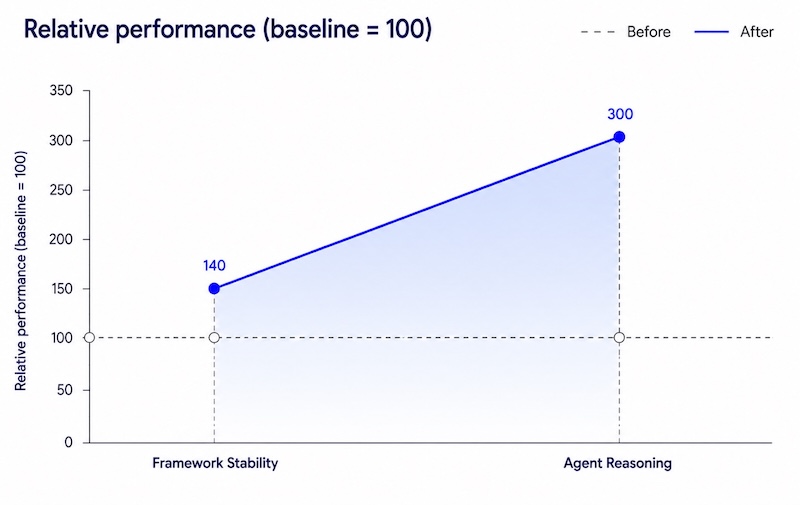
Agentic AI framework optimization is the process of auditing existing agent workflows, resolving stability and reliability failures, enhancing agent reasoning capabilities, and extending the system to support advanced LLM and tool-based interactions across multiple large language model environments. ICANIO delivered an optimization engagement that achieved 40% improved framework stability, 3x enhanced agent reasoning and decision capability, and multi-model compatibility across local and cloud LLM environments for an enterprise AI platform requiring expanded and more reliable system performance. ICANIO Technologies delivered this as a full-stack AI agent development engagement, auditing pre-built components, designing custom collaborative and reflective reasoning agents, and implementing a scalable deployment architecture to support evolving enterprise AI use cases.
Enterprise agentic deployments face a structural challenge that becomes more acute as use case complexity grows. Pre-built agent components that perform adequately in isolated tests expose reliability gaps when placed under the demands of production agent workflows, where agents must reason across multiple steps, invoke tools reliably, coordinate with other agents, and maintain consistent behaviour across agent environments. Without systematic audit, debugging, and optimization of these components, the framework accumulates instability that degrades with every new use case it is asked to support.
ICANIO approached this as a full-stack engineering challenge. The objective was to audit every existing agent workflow for stability failures, optimize reasoning chains for consistent optimization outcomes, design new custom agents capable of collaborative and reflective reasoning, enable advanced agent interactions across multiple LLM environments, maintain low-code architecture, and deliver scalable deployment infrastructure for future use cases. The result was a stable, performant, and extensible framework capable of supporting the evolving enterprise AI use cases that a high-growth AI platform requires at production scale.
“An agentic AI framework that works in isolation but fails in production is not an AI problem. It is an architecture and workflow engineering problem that requires systematic optimization before it can scale.”
Without systematic optimization, every unresolved workflow failure compounds the next. Unstable agents produce inconsistent reasoning outputs. Inconsistent outputs trigger downstream errors in dependent agents. Downstream errors in agent pipelines accumulate into reliability failures that erode confidence in the entire framework. Limited compatibility restricts which environments the framework can operate in. Restricted environments limit the development velocity of teams building on the platform. Six distinct failure modes defined the pre-engagement state.
Existing agent workflows contained unresolved stability and reliability issues that had accumulated without systematic debugging. Without structured audit processes, instability propagated through reasoning chains without clear root cause identification or resolution.
Pre-built components produced inconsistent behaviour across agent reasoning chains, creating unpredictable reasoning outcomes. The absence of standardized reasoning patterns meant that identical inputs could produce divergent outputs across different agent executions.
Limited agent capabilities restricted advanced tool-based integration and external system interactions. Without the ability to invoke tools reliably within agent workflows, agents could not perform the complex, multi-step task sequences that advanced AI use cases require.
Multi-agent system scalability challenges affected the framework’s ability to support complex agent coordination patterns. Without a redesigned framework architecture, the system could not expand to accommodate new agents or more demanding reasoning workflows without degrading overall performance.
The absence of optimized reasoning pipelines reduced overall framework efficiency. Without optimized chain-of-thought and reflective reasoning patterns, agents consumed more computation than necessary and produced less reliable outputs than the underlying model was capable of delivering.
ICANIO designed and delivered a structured optimization programme that addresses every stability and capability gap identified in the pre-engagement audit. Each component of the enhancement feeds directly into the next, ensuring that agent debugging, AI workflow optimization, custom agent design, low-code architecture, and scalable deployment operate as a single coordinated programme for agent work.
01
Reviewed and debugged existing agentic AI framework agents to resolve unresolved stability issues, producing a cleaned inventory where every multi-agent system component behaves reliably.
02
Optimized agent reasoning workflows and tool invocation patterns to ensure consistent AI workflow optimization outcomes, eliminating inconsistent reasoning behaviour across agent executions.
03
Designed custom agents supporting collaborative reasoning across multi-agent system pipelines and reflective self-correcting behaviour within the framework.
04
Enabled AI agent development across multiple LLM integration environments, including local and cloud deployments, giving the framework flexibility across diverse architectures.
05
Maintained the low-code architecture throughout the optimization programme, preserving AI agent development velocity while delivering stability and capability improvements.
06
Implemented scalable agent deployment infrastructure within the optimization framework, allowing new agents to be added without degrading existing system performance.
The optimization programme fundamentally changed how this enterprise AI platform operates, converting an unstable, capability-limited system into a reliable, extensible, and multi-LLM compatible AI workflow optimization environment.
Framework stability and reliability across all framework agent workflows
Local and cloud LLM integration support across all deployment environments
Advanced multi-agent system support for evolving AI agent development needs
Agent reasoning and decision capability through optimized multi-agent system design
Consistent AI workflow optimization and agent reasoning chain execution
Flexible agentic framework for long-term enterprise AI use case expansion
01
The most common failure mode in enterprise agentic deployments is extending agent capabilities before resolving the stability issues already present in the existing component set. Adding new agents, new LLM environments, or new agent coordination patterns to an unstable foundation does not produce a more capable framework. It produces a more complex unstable one. ICANIO’s audit-first approach to this engagement confirms that systematic AI workflow optimization and stability debugging must precede capability extension. AI platform leaders planning agentic optimization programmes should treat the audit and debugging workstream as a prerequisite, not a parallel activity, to agent capability work.
02
The 3x improvement in agent reasoning and decision capability delivered through this engagement was not produced by switching to a more powerful LLM. It was produced by optimizing the reasoning chain architecture, tool invocation patterns, and collaborative agent design within the existing system. LLM integration quality, prompt structure, chain-of-thought design, and agent coordination logic determine reasoning output quality at least as much as the underlying model capability does. AI agent development leaders who attribute poor framework performance exclusively to model limitations and respond by scaling up their model tier are often solving the wrong problem. Optimize the framework architecture first.
03
The low-code architecture decision that underpins this framework is not a constraint on AI agent development capability. It is an accelerant when maintained with the same engineering discipline applied to code-first frameworks. ICANIO’s engagement demonstrated that a low-code framework can support production deployments, advanced multi-environment support across local and cloud environments, collaborative and reflective reasoning agents, and scalable infrastructure, without sacrificing the AI agent development velocity that makes low-code tooling commercially valuable. Enterprise AI platform leaders evaluating agentic framework architecture should assess low-code options against production-grade engineering standards rather than dismissing them on the basis of perceived capability limits.
Stability of the agentic framework is not a deployment concern to be addressed after agent capabilities are built. It is the foundational requirement on which every agent capability, every LLM integration, and every coordination pattern depends. This engagement demonstrates that with the right audit-first, optimization-led approach, enterprise AI platforms can resolve existing instability, extend agent capabilities, and deliver multi-LLM compatibility simultaneously within a single structured optimization programme.
By treating this as a full-stack engineering challenge rather than a configuration and prompt exercise, ICANIO helped this enterprise AI platform achieve 40% stability improvement, 3x reasoning enhancement, and a scalable AI agent development foundation that will continue to grow with evolving AI use cases. The stability gains, the reasoning improvements, and the multi-environment compatibility are not one-time outcomes. They are the engineering baseline from which every future optimization and AI agent development initiative on this platform will be built.
An agentic AI framework is an architecture for deploying AI agents that can reason, use tools, and coordinate with other agents to complete complex multi-step tasks autonomously across one or more LLM environments. This type of optimization is required when pre-built agent components develop stability issues, reasoning chains produce inconsistent outputs, or the system needs to expand to new LLM environments or more complex optimization patterns. ICANIO's optimization engagement resolved accumulated instability, extended agent capabilities, and enabled multi-LLM compatibility across the full framework.
Multi-agent system optimization improves reasoning performance by redesigning agent coordination patterns, optimizing tool invocation logic, and introducing collaborative and reflective reasoning agents that self-correct and share context across the pipeline. ICANIO's engagement delivered a 3x improvement in agent reasoning and decision capability not by upgrading the underlying model but by optimizing the chain-of-thought architecture, inter-agent communication, and optimization design within the existing multi-agent system.
LLM integration across multiple environments for an agentic framework involves configuring agent logic to operate against both local LLM deployments and cloud-hosted LLM APIs, abstracting the model interface so that agent work is not coupled to a specific LLM environment, and validating that reasoning outputs are consistent across different model configurations. ICANIO's LLM integration work enabled the framework to support diverse deployment scenarios without rebuilding core agent logic for each environment.
AI workflow optimization in an agentic context refers to the design and refinement of agent reasoning chains, tool-use sequences, and coordination patterns to maximize output consistency, minimize unnecessary computation, and ensure that every agent in the pipeline performs its intended function reliably. ICANIO's AI workflow optimization work eliminated the divergent reasoning outputs and tool invocation failures that had previously degraded framework performance across production use cases.
Low-code architecture supports production framework deployment by providing visual workflow design, pre-built model connectors, and rapid agent development tooling that reduce the engineering time required to build, test, and deploy new agents. ICANIO maintained the low-code architecture throughout this optimization engagement, demonstrating that low-code tooling can support production deployment, multi-environment integration, and advanced AI workflow optimization without sacrificing the development velocity benefits that make low-code frameworks commercially attractive.
Optimization timelines depend on the number of existing agents requiring audit and debugging, the complexity of the coordination patterns to be optimized, the number of LLM environments to be configured, and the scope of new agent work required to meet the platform's evolving use case requirements. ICANIO's approach sequences the engagement to deliver stability improvements through the debugging workstream first, enabling measurable reliability gains before new agent capabilities are introduced through the system extension phase.

ICANIO’s engineering team is available for a no-obligation discovery call to assess your requirements, map your integration readiness, and AI automation delivery plan suited to your organisation’s scale, compliance environment, and clinical workflows.
From bold ideas to breakthrough execution – our case studies showcase how we transform business challenges into innovation-led success stories.
ICANIO built an AI-powered healthcare record digitization platform that cut manual data entry by 60% and improved patient record accessibility 4x.
ICANIO built an AI-powered healthcare record digitization platform that cut manual data entry by 60% and improved patient record accessibility 4x.

ICANIO built a digital healthcare platform integrating patient records, telemedicine, EHR, billing, wearables, and AI insights, reducing administrative workload by 40% and improvin

ICANIO built a healthcare backend engineering platform that delivered services 2x faster, reduced operational risk by 30%, and improved scalability, reliability, and integration.

ICANIO built an AI-powered healthcare record digitization platform that cut manual data entry by 60% and improved patient record accessibility 4x.

ICANIO built a multi-tenant LLM fine-tuning pipeline on Azure OpenAI with isolated client models, automated DeepEval quality gates, MLflow tracking, and complete training lineage.
Quick Links
Careers
Internship
Contact Sales
© 2025
Icanio - All rights reserved.
