05 Mar 2026

Developer Growth & Problem-Solving Playbook

This document serves as a standard operating procedure (SOP) for engineers looking to level up their technical skills, product intuition, and efficiency when facing blockers.
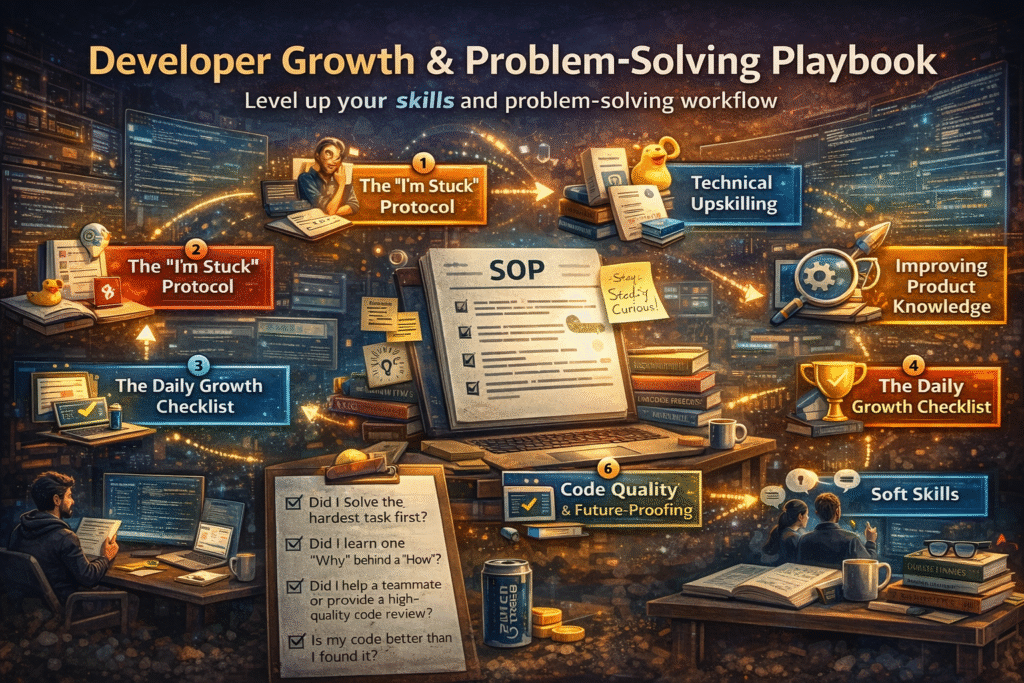
1. The "I’m Stuck" Protocol

Stop the “spin” and start the solve.

When you hit a technical wall, don’t just stare at the screen. Follow these steps:

  • The 15-Minute Rule: Spend 15 minutes trying to solve it yourself (docs, logs, debugger). If you haven’t made progress, you must document what you’ve tried and prepare to ask for help.
  • Rubber Ducking: Explain the code, line by line, to a teammate (or a literal rubber duck). Most bugs are found when you’re forced to verbalize the logic.
  • Isolate the Variable: Create a “minimal reproducible example.” Does the error happen in a blank file with just that one function? If not, the issue is in your environment or integration.
  • The “Ask” Template: When reaching out to a senior or peer, use this format:
    1. Goal: “I’m trying to [Action].”
    2. The Error: “I’m getting [Error Message/Behavior].”

The Effort: “I’ve already checked [Log/File] and tried [Solution A].”

2. Technical Upskilling (The "How")

Move from “coder” to “architect.”

Daily Habits

  • Read One PR (Pull Request): Spend 10 minutes reading a PR from a senior dev. Look at their naming conventions, how they handle edge cases, and their architectural choices.
  • Code Reviews: Don’t just LGTM (“Looks Good To Me”). Ask why a certain library was used or suggest a more performant way to handle a loop.

Deep Work

  • The “Why” Behind the “How”: If you use a library or a framework feature, read the source code or the documentation for 5 minutes to understand how it works under the hood.
  • Side Projects vs. Deep Dives: Instead of building 10 “To-Do” apps, take one complex topic (e.g., Database Indexing or Garbage Collection) and write a blog post or internal note about it.

3. Improving Product Knowledge

A great developer understands the ‘Why’ before the ‘What’.

To build better features, you must understand the user:

  • Shadow a Sales/Support Call: Listen to how users actually use the tool. Their “pain points” are your future features.
  • The Business Metric: Ask your Product Manager: “Which metric does this feature move?” (e.g., Conversion, Retention, or Latency).
  • Eat Your Own Dog Food: Use the product you are building every day. If it’s frustrating for you, it’s frustrating for the customer.

4. The Daily Growth Checklist

A simple routine for consistent improvement.

Time

Task

Objective

Morning

Review Today’s Tickets

Identify the “Hardest Task” and do it first (Eat the Frog).

Lunch/Break

Tech News/Newsletter

Stay updated on industry trends (TLDR, Hacker News, etc.).

Mid-Day

Deep Work Block

2 hours of no-slack, no-meeting coding.

End of Day

Work Log

Write down 3 things you learned or solved today.

5. Code Quality & Future-Proofing

Write code for the developer who has to maintain it in six months (which will probably be you).

  • The “Boy Scout” Rule: Always leave the code slightly cleaner than you found it. If you see a messy function while fixing a bug, refactor it if it’s within scope.
  • Documentation as Code: Don’t just comment what the code is doing (the code should tell you that). Comment why it’s doing it.
    • Bad: // increment i by 1
    • Good: // we offset by 1 here to account for the legacy header in the API response

Test-Driven Thinking: Even if you don’t use strict TDD (Test Driven Development), write your code so it is testable. If a function is too hard to test, it’s usually too complex.

6. Soft Skills: The "Force Multipliers"

Coding is only 50% of the job. The rest is communication.

  • The Art of the Review: When reviewing others’ code, use “I” statements or questions.
    • Instead of: “This is wrong, use a Map here.”
    • Try: “I’m curious if a Map might be more performant here given the scale—what do you think?”
  • Managing Up: Don’t wait for your lead to ask for an update. Provide a “Pulse Check” at the end of the day: What I did, where I’m stuck, and what’s next.
  • Writing for Humans: Write your tickets and documentation so that a non-technical stakeholder could understand the impact of your work.

7. Strategic Debugging Framework

Move from “guessing” to “verifying.”

When a bug appears, follow the Scientific Method:

  1. Observe: Identify exactly where the behavior deviates from the expectation.
  2. Hypothesize: “I think the data is null because the API call is timing out.”
  3. Test: Add a log or a breakpoint. If the API call isn’t timing out, your hypothesis was wrong. Move to the next one.
  4. Analyze: Never move on until you understand why the fix worked. “Magic fixes” always come back to haunt you.

8. Continuous Learning (The 1% Rule)

Compounding interest applies to knowledge, too.

  • The Tech Debt Log: Keep a personal list of things you used today but didn’t fully understand (e.g., “What is a JWT secret actually doing?”). Spend 10 minutes at the end of the week researching one item.
  • Listen to Post-Mortems: When a major system fails, read the Incident Report. Understanding how systems break is the fastest way to learn how to build them properly.

Mentor Someone: Teaching a junior developer or an intern is the ultimate test of your own knowledge. If you can’t explain it simply, you don’t understand it well enough.

Related Case Studies

From bold ideas to breakthrough execution — our case studies showcase how we transform business challenges into innovation-led success stories.

Icanio optimized cloud costs by reducing spend 15–25%, improving visibility, governance, and accountability, while enabling predictable, scalable, and efficient cloud operations

Explore Related Services

Wondering how high-growth companies automate deployments and scale infrastructure without downtime? Explore our DevOps & Cloud Engineering services.