Endpoint Detection and Response has become a business-critical security requirement in 2026, with ransomware attacks, supply chain breaches, and advanced persistent threats hitting organisations of every size across every industry. The platform comparison that matters for most enterprise security teams comes down to three platforms that dominate the market: CrowdStrike Falcon, SentinelOne Singularity, and Microsoft Defender for Endpoint. All three rank at the top of Gartner’s EDR Magic Quadrant, all three perform strongly in independent MITRE ATT&CK evaluations, and all three deliver genuine enterprise-grade endpoint protection. The difference is in architecture: each platform is built on a fundamentally distinct philosophy, and those architectural differences determine which organisations each platform serves best in practice.
ICANIO Technologies works with enterprise clients across the USA, UK, Germany, Australia, and Malaysia on DevOps and Cloud Engineering engagements where EDR platform comparison and selection is a recurring component of security architecture programs.
This comparison covers how CrowdStrike, SentinelOne, and Microsoft Defender for Endpoint differ architecturally, how they perform in MITRE ATT&CK evaluations and real-world scenarios, what makes each platform uniquely suited to specific environments, and how enterprises are deploying them in practice in 2026. The CrowdStrike vs SentinelOne vs Microsoft Defender evaluation is not a question of which is objectively best but which matches a given organisation’s infrastructure, team maturity, compliance obligations, and operational model.
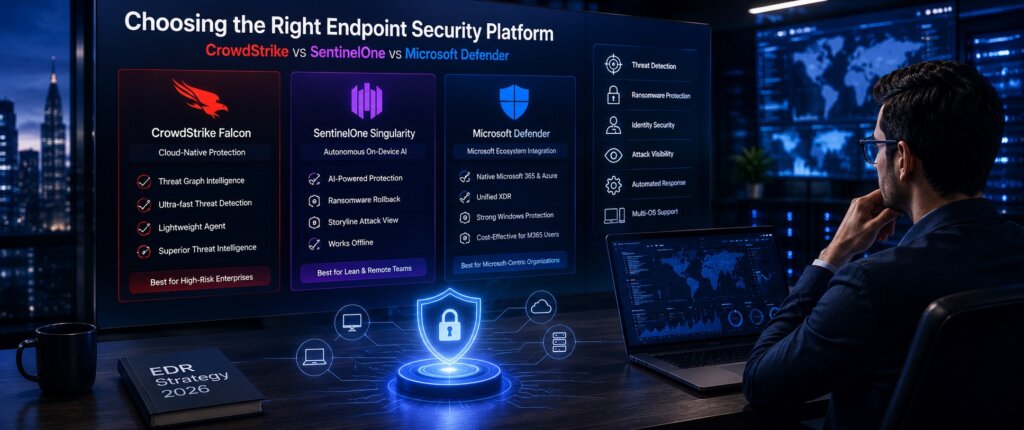
CrowdStrike Falcon is a cloud-native endpoint protection platform built around a lightweight single agent that sends endpoint telemetry to CrowdStrike’s cloud for analysis at massive scale. The Falcon platform processes over two trillion events per week through its Threat Graph, giving it adversary intelligence depth that no on-device model can match. CrowdStrike covers endpoint detection and response, next-generation antivirus, threat intelligence, identity protection across Active Directory and Entra ID, and cloud workload security through a modular architecture where capabilities are added as separate components. The CrowdStrike vs SentinelOne architectural distinction starts here in the EDR platform comparison: CrowdStrike centralises intelligence in the cloud for maximum breadth, while SentinelOne distributes it to the endpoint for maximum autonomy.
SentinelOne takes a fundamentally different approach to EDR platform design. Its AI runs entirely on-device, providing full detection and response capability even when endpoints are offline or have no cloud connectivity. This autonomous architecture powers its flagship capabilities: the Storyline attack chain visualisation that maps the complete sequence of attacker activity, automated ransomware rollback that restores encrypted files without paying a ransom or restoring from backup, and real-time behavioural analysis that operates independently of cloud connectivity.
SentinelOne’s endpoint detection and response base tier includes cloud workload security and network discovery capabilities that CrowdStrike offers as separate add-on modules, making the total platform scope broader at the entry tier. For the CrowdStrike vs SentinelOne evaluation on operational completeness, this inclusion matters.
SentinelOne is best suited for lean security teams, remote-heavy environments, and organisations that want powerful automated protection without constant human oversight.
This platform has evolved well beyond its origins as basic Windows antivirus. For organisations running primarily Windows environments deeply integrated with Microsoft 365 and Azure, Defender XDR is a genuinely capable enterprise security platform with the distinct advantage of being included within Microsoft 365 E5 licensing without additional platform spend. Microsoft Defender for Endpoint integrates natively with Microsoft Sentinel, Entra ID, Purview, Intune, and the Microsoft Security Graph, making it the lowest-friction path for Windows-centric organisations. The EDR platform comparison for Defender focuses primarily on its deep Microsoft ecosystem integration and its performance gaps on non-Windows operating systems, which MITRE ATT&CK evaluations have surfaced as a meaningful limitation for mixed-OS environments.
MITRE ATT&CK evaluations represent the most rigorous independent benchmark in the endpoint detection and response market, testing platforms against realistic attack scenarios mapped to the MITRE ATT&CK framework. The 2025 MITRE ATT&CK evaluations results are informative for any EDR platform comparison exercise.
CrowdStrike achieved 100% protection and detection scores in the 2025 MITRE ATT&CK evaluations, a benchmark result that matters particularly for enterprises defending high-risk environments like trading terminals, critical infrastructure, or systems handling highly sensitive data. CrowdStrike’s average remediation time of 12 minutes, compared to 38 minutes for competitors, directly translates to reduced business impact from confirmed incidents. SentinelOne delivered consistently strong MITRE ATT&CK evaluations results, and its on-device AI provides a unique advantage in detecting threats without cloud connectivity during the evaluation scenarios that test offline behaviour. Microsoft Defender for Endpoint showed capable overall performance in MITRE ATT&CK evaluations but logged 24 missed detections on macOS in recent rounds, a real limitation for organisations running mixed operating system environments.
CrowdStrike’s threat intelligence is its clearest differentiator in the CrowdStrike vs SentinelOne comparison. Its Threat Graph aggregates telemetry from millions of endpoints globally, enabling deeply detailed adversary profiles that cover nation-state threat actors, advanced persistent threat groups, and complex supply chain attack patterns. For enterprises facing sophisticated adversaries, this intelligence depth is a genuine operational advantage that on-device models operating on local telemetry cannot replicate at the same scale.
The OverWatch managed detection and response add-on extends this intelligence into a 24/7 SOC service, making CrowdStrike a viable option for organisations that want to outsource threat hunting to specialists rather than building internal capability.
SentinelOne’s differentiator in the CrowdStrike vs SentinelOne comparison is autonomous response speed. In a documented CrowdStrike vs SentinelOne real-world differentiation case, a zero-day exploit hit a branch endpoint during off-hours: the SentinelOne agent detected ransomware encryption behaviour, rolled back the encrypted files, and isolated the endpoint before the on-call analyst received the alert, with a recovery time under four minutes and zero data loss. This level of autonomous response is impossible with platforms that require cloud connectivity for detection decisions. The Storyline technology automatically correlates related events into a complete attack chain narrative, reducing alert noise by 60 to 70% according to a 2026 SANS survey of 240 IT organisations.
For organisations managing lean security teams, this operational efficiency is as valuable as detection depth in the CrowdStrike vs SentinelOne capability comparison. For organisations managing lean security teams, this operational efficiency is as valuable as detection depth.
CrowdStrike leads the EDR platform comparison on threat intelligence depth, processing over two trillion events weekly with adversary profile coverage unmatched in the industry. Its 12-minute average remediation time versus 38 minutes for competitors directly reduces business continuity impact from confirmed incidents. OverWatch managed detection and response is available as an add-on for organisations that want to outsource SOC operations to specialist analysts rather than building internal capability. The modular Falcon architecture allows organisations to mix and match capabilities precisely matched to their risk profile, adding identity protection, cloud workload security, and threat intelligence as separate components.
CrowdStrike is best suited for enterprises with dedicated SOC teams or MSP relationships that can leverage the platform’s full investigative and threat hunting depth.
SentinelOne leads the EDR platform comparison on offline autonomous protection, providing full AI-driven endpoint detection and response even without internet connectivity, critical for remote endpoints, ATMs, branch offices, and air-gapped environments. Automated ransomware rollback, a capability CrowdStrike does not offer natively, restores encrypted files automatically after an attack. Storyline reduces alert noise by 60 to 70% and dramatically shortens the time from detection to investigation understanding.
Data sovereignty is built in: SentinelOne retains 100% of endpoint detection and response data on-device for up to 90 days without cloud upload, aligning with data residency and privacy regulations relevant to clients in Germany, the UK, and Australia. Cloud workload security and network discovery are included in base tiers rather than sold as add-ons. SentinelOne is best suited for lean security teams, remote-heavy environments, and organisations that want powerful automated protection without constant human oversight.
Microsoft Defender for Endpoint wins the EDR platform comparison on ecosystem integration for organisations running primarily Windows and Microsoft 365. Native connectivity with Sentinel, Entra ID, Purview, Intune, and the Microsoft Security Graph produces a unified security operations experience without third-party connectors. Compliance automation for GDPR, Azure data residency requirements, and regulatory audit trails reduces manual overhead for organisations operating under European and UK regulatory frameworks. No agent installation is required on Windows, reducing deployment complexity and IT overhead. Defender is best suited for organisations where the Microsoft ecosystem forms the primary security operations foundation, and where non-Windows operating system gaps can be accepted or addressed through supplemental tooling.
Organisations in 2026 rarely deploy a single endpoint detection and response platform across their entire estate. Platform selection in most enterprise security architecture decisions now ends not with one winner but with a layered deployment architecture that uses different platforms for different risk tiers and environments. ICANIO’s DevOps and Cloud Engineering teams help enterprise clients in the USA, UK, Germany, and Australia design these layered architectures rather than defaulting to single-platform deployments that compromise either coverage depth or operational cost efficiency.
Risk-tiered deployment is the most common pattern: Defender across standard workstations for operational efficiency, with CrowdStrike deployed on high-risk endpoints including trading terminals, privileged administrator workstations, and executive devices. This hybrid approach directs maximum telemetry and intelligence depth where risk is highest. Branch and core split is the second common pattern: SentinelOne at branch offices, ATMs, and remote endpoints where offline autonomous protection is essential, with CrowdStrike or Defender in centralised data centre environments where connectivity is reliable and threat intelligence depth matters more. The third pattern layers a managed detection and response service on top of Defender for Microsoft 365-centric organisations, adding 24/7 SOC coverage and detection depth that Defender alone may not provide across all threat categories.
An EDR platform comparison for a specific organisation should start with four operational questions rather than with vendor feature lists.
The first question is the primary operating environment. Organisations running primarily Windows and Microsoft 365 should evaluate Microsoft Defender for Endpoint seriously before committing to a separate platform. Mixed operating system environments with significant macOS and Linux coverage are best served by SentinelOne. CrowdStrike operates across all OS types with strong results but may require add-on modules for specific environments. The second question is security team maturity and staffing. CrowdStrike rewards organisations with dedicated security operations capability: the platform’s depth requires trained analysts to leverage fully. SentinelOne’s autonomous approach requires less hands-on management, making it well-suited for lean IT and security teams. Defender is the lowest-overhead option for Microsoft-integrated environments.
The third question is endpoint connectivity. SentinelOne’s on-device AI is the definitive choice for remote workers, branch offices, ATMs, and any environment with intermittent connectivity. CrowdStrike’s most effective capabilities degrade without cloud connectivity. The fourth question is compliance and data residency requirements. Defender has the strongest native compliance automation for Microsoft-integrated regulated environments. SentinelOne’s 90-day on-device telemetry retention directly supports data residency requirements without cloud upload, relevant for GDPR-governed operations in Germany and the UK and for Australian Privacy Act compliance. CrowdStrike requires additional configuration to satisfy the same data residency requirements.
ICANIO’s DevOps and Cloud Engineering practice supports platform comparison and selection for enterprise clients across the USA, UK, Germany, Australia, and Malaysia, covering platform architecture evaluation, MITRE ATT&CK evaluations interpretation, deployment architecture design, and implementation support for CrowdStrike, SentinelOne, and Microsoft Defender for Endpoint environments. ICANIO helps clients design layered endpoint detection and response architectures that match actual risk profiles rather than defaulting to single-platform deployments that create either coverage gaps or operational overhead that does not fit the team’s maturity level.
The company’s development teams, based out of Tirunelveli with a branch office in Chennai, bring together DevOps and Cloud Engineering, Data and AI, Application Development, and Support Engineering capability for these engagements. ICANIO’s ISO 9001:2015 and ISO 27001:2013 certifications provide enterprise clients in the USA, UK, and Germany with the documented security management framework that procurement and information security teams require from partners involved in endpoint detection and response platform selection and implementation for production environments.
There is no single best platform in this EDR platform comparison. CrowdStrike leads on threat intelligence depth and remediation speed, making it ideal for enterprises with a dedicated SOC. SentinelOne leads on autonomous protection and offline capability, making it best for lean teams and remote-heavy environments. Defender wins on ecosystem integration and inclusion in Microsoft 365 E5 for organisations already embedded in the Microsoft stack. The right CrowdStrike vs SentinelOne vs Defender choice depends on infrastructure, team maturity, and compliance requirements.
Yes. Many enterprises run Microsoft Defender for Endpoint across standard workstations and deploy CrowdStrike on high-risk endpoints such as trading terminals, privileged admin workstations, and executive devices. Coexistence between Defender and CrowdStrike is supported and documented by both vendors, with Defender operating in passive mode that provides telemetry without conflicting with CrowdStrike’s active enforcement.
Yes. SentinelOne’s AI runs entirely on-device, providing full endpoint detection and response capability even when endpoints are offline. This makes it particularly well-suited for remote workers, branch offices, ATMs, and environments with intermittent connectivity, a scenario where CrowdStrike’s cloud-dependent features are limited and Microsoft Defender for Endpoint provides only partial offline coverage.
The July 2024 CrowdStrike update that caused widespread Blue Screen of Death issues increased scrutiny of update governance practices across all EDR vendors and benefited SentinelOne and Microsoft Defender as organisations reconsidered vendor concentration risk. CrowdStrike retained the majority of its customer base and updated its update rollout processes. The incident remains a valid consideration when evaluating update governance practices for any endpoint detection and response platform, not exclusively CrowdStrike.
SentinelOne handles mixed operating system environments most consistently in this EDR platform comparison. Defender logged 24 missed detections on macOS in recent MITRE ATT&CK evaluations rounds, making it a weaker choice for organisations with significant macOS deployments. CrowdStrike provides good macOS coverage but performs best on Windows. SentinelOne delivers excellent detection and response across Windows, macOS, and Linux with consistent performance across all three operating systems.
Quick Links
Careers
Internship
Contact Sales
© 2025
Icanio - All rights reserved.