
05 Mar 2026

Understanding SQL Server ACID & Isolation Levels

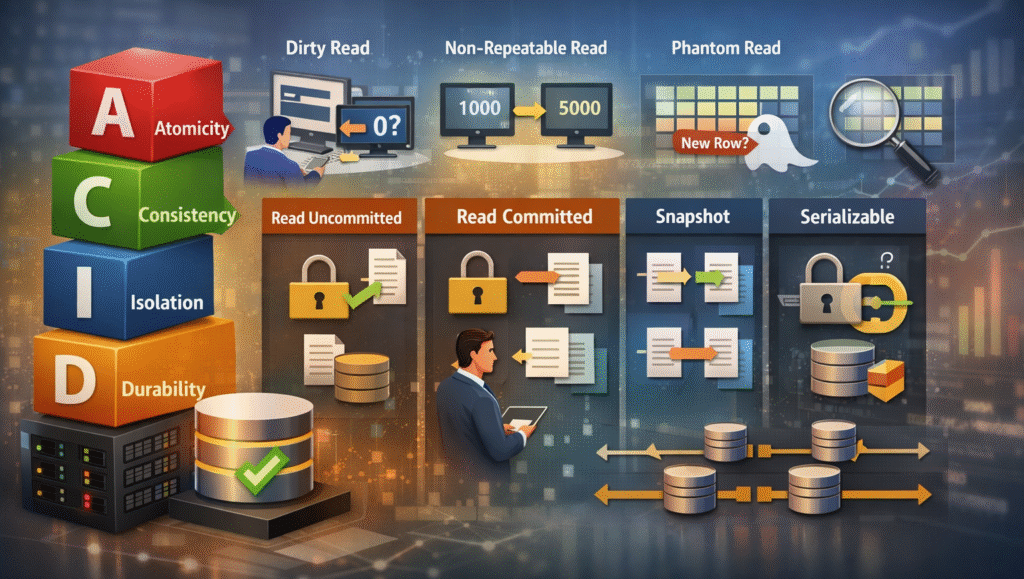
When building enterprise applications using MS SQL Server, especially in high-concurrency systems (banking, e-commerce, booking systems), understanding ACID properties and Isolation Levels is critical.
This turns high-cost AI investments into shelfware—not because models were poorly built, but because systems were never designed for long-term operation.

In this article, we’ll cover:

  • What is ACID?
  • What is Isolation?
  • Locks (Shared & Exclusive)
  • Read Block Write / Write Block Read
  • Dirty Reads, Non-Repeatable Reads, Phantom Reads
  • Isolation Levels in SQL Server:
    1) READ UNCOMMITTED
    2) READ COMMITTED (with and without Snapshot)
    3) SNAPSHOT
    4) SERIALIZABLE
  • Behavior in parallel transactions
  • SQL examples for each level
  • Summary comparison table

1. What is ACID

ACID ensures reliable database transactions. Atomicity means all operations succeed or none do. Consistency keeps data valid according to rules and constraints. Isolation prevents concurrent transactions from interfering incorrectly. Durability guarantees that once committed, data remains permanently stored, even after failures.

2. What is Isolation?

Isolation defines how one transaction behaves when multiple transactions run in parallel.

Without isolation control, you may face:

  • Dirty Reads
  • Non-repeatable Reads
  • Phantom Reads

3. Understanding Locks in SQL Server

SQL Server uses locks to maintain consistency.

Shared Lock (S Lock)

  • Applied during read

  • Multiple shared locks allowed

  • Blocks writers

BEGIN TRAN

SELECT * FROM Accounts WHERE Id = 1;

— Shared lock applied

Exclusive Lock (X Lock)

  • Applied during insert/update/delete
  • Blocks both readers and writers

BEGIN TRAN

UPDATE Accounts SET Balance = 5000 WHERE Id = 1;

— Exclusive lock applied

4. Read Block Write & Write Block Read

Read Block Write | Shared lock prevents update
Write Block Read | Exclusive lock prevents read
Write Block Write | Exclusive locks block each other

5. READ UNCOMMITTED

What is it?

Lowest isolation level, Allows Dirty Reads.

Equivalent to:

SET TRANSACTION ISOLATION LEVEL READ UNCOMMITTED;

Or:

SELECT * FROM BankAccount WITH (NOLOCK);

6. READ COMMITTED (Default)

Default isolation level in SQL Server.

SET TRANSACTION ISOLATION LEVEL READ COMMITTED;

What it prevents

  • Prevents Dirty Reads
  • Allows Non-repeatable Reads
  • Allows Phantom Reads

7. READ COMMITTED SNAPSHOT (RCSI)

Enabled at database level:

ALTER DATABASE YourDB

SET READ_COMMITTED_SNAPSHOT ON;

What changes?

  • No shared locks for reads
  • Uses row versioning
  • Readers don’t block writers
  • Writers don’t block readers

How it works

SQL Server stores previous row versions in tempdb.

Readers get the last committed version instead of waiting.

8. SNAPSHOT Isolation

Enabled using:

ALTER DATABASE YourDB SET ALLOW_SNAPSHOT_ISOLATION ON;

Used inside transaction:

SET TRANSACTION ISOLATION LEVEL SNAPSHOT;

BEGIN TRAN

What it prevents

  • Dirty Reads
  • Non-repeatable Reads
  • Phantom Reads

Uses row versioning.

10. SERIALIZABLE

Highest isolation level.

SET TRANSACTION ISOLATION LEVEL SERIALIZABLE;

What it prevents

  • Dirty Reads
  • Non-repeatable Reads
  • Phantom Reads

How?

Uses range locks.

FAQs

Because organizations treat AI as a project instead of a living system requiring continuous monitoring, ownership, and retraining.
Yes. Drift is natural. Failure comes from ignoring it.
A single accountable owner responsible for performance, updates, and outcomes—not a shared committee.
Define post-launch ownership and monitoring before deployment—not after problems appear.

Related Case Studies

From bold ideas to breakthrough execution — our case studies showcase how we transform business challenges into innovation-led success stories.

Icanio optimized cloud costs by reducing spend 15–25%, improving visibility, governance, and accountability, while enabling predictable, scalable, and efficient cloud operations

Explore Related Services

Wondering how high-growth companies automate deployments and scale infrastructure without downtime? Explore our DevOps & Cloud Engineering services.