Manufacturing digital transformation in 2026 carries a constraint that most enterprise IT modernization guides don’t adequately account for: production lines cannot pause while migrations happen. A financial services firm that takes its core banking system offline for a weekend migration accepts a defined window of service unavailability. A manufacturer that takes its manufacturing execution system offline stops production, with compounding downstream effects on supply commitments, workforce scheduling, and contractual delivery obligations. Manufacturing digital transformation requires a fundamentally different architectural approach from generic IT modernization, one designed around zero-downtime migration rather than planned cutover windows, and around the operational technology systems that run production floors.
PLCs, SCADA, DCS, and MES carry different availability requirements than the enterprise IT systems most modernization frameworks were built to address.
ICANIO Technologies has worked with manufacturing clients across several industry contexts on legacy system modernization, ERP modernization, and industrial software migration projects, and the pattern that separates successful manufacturing digital transformation programs from ones that stall or cause production incidents is consistent: phased approaches that build new capabilities alongside existing systems rather than replacing them, and that start with data access rather than application replacement. This piece walks through the phased migration architecture, the manufacturing-specific constraints that shape it, and the sequence of decisions that determine whether a manufacturing digital transformation program delivers operating value at each stage or requires the entire program to complete before anything improves.
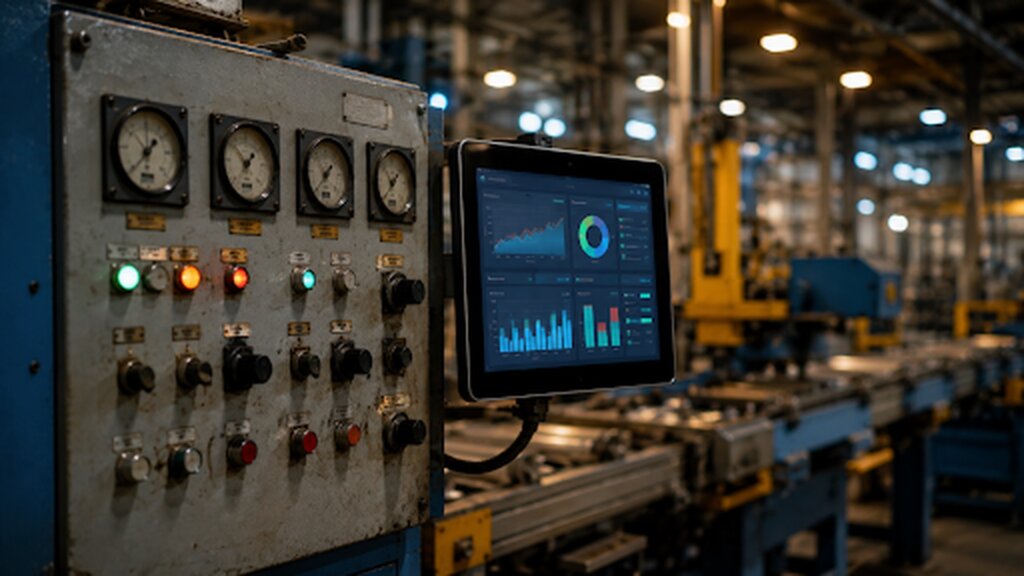
Manufacturing digital transformation involves two distinct technology layers that most IT-focused modernization frameworks treat as one. The enterprise IT layer includes ERP systems, supply chain management software, quality management systems, and business intelligence platforms that manufacturing organizations share with other industries.
The operational technology layer includes PLCs, SCADA systems, distributed control systems, and manufacturing execution systems that are specific to manufacturing environments and carry fundamentally different availability, security, and update requirements than enterprise IT systems. A program that addresses only the enterprise IT layer without connecting it to the OT layer produces better business reporting but doesn’t change how production actually runs. Genuine transformation requires bridging these two layers in a way that improves both operational efficiency and business visibility simultaneously.
The convergence of operational technology and information technology networks is one of the defining challenges of manufacturing digital transformation in 2026. OT systems were historically air-gapped from enterprise IT networks for security and reliability reasons, running proprietary protocols on isolated networks where uptime was the absolute priority.
Manufacturing digital transformation that connects these systems to enterprise IT networks and cloud infrastructure to enable real-time data access and AI-driven optimization creates new attack surfaces alongside the new capabilities. IEC 62443, the international standard for industrial cybersecurity, provides the security architecture framework that manufacturing digital transformation programs need to address this OT/IT convergence safely, and ICANIO’s DevOps and Cloud Engineering practice treats IEC 62443 compliance as a first-class architecture requirement in every manufacturing engagement, not a compliance checkbox added after integration is designed.
This security discipline is what allows modernization programs to capture the efficiency gains of OT/IT convergence without accepting the security exposure that unmanaged connectivity between production networks and enterprise systems introduces.
Legacy system modernization in manufacturing almost always fails when it follows the big-bang replacement model: identify the target state, build the new system, migrate everything, retire the old system. This approach has a well-documented failure rate in any industry, but it is especially risky in manufacturing where the systems being replaced run production operations that cannot tolerate the extended parallel running period that a full replacement requires. The most consistently successful legacy system modernization approach in manufacturing is the Strangler Fig pattern.
Build new functionality alongside the existing system, route increasing volumes of work to the new system as confidence builds, and retire the legacy system only after the new system has proven itself in production over an extended period.
The right entry point for legacy system modernization in manufacturing is almost always data access rather than application replacement. Legacy manufacturing systems typically contain years or decades of operational data, production records, quality event histories, and maintenance records that have genuine analytical value but are locked inside proprietary database schemas or flat file structures that modern analytics and AI tools can’t consume directly. Legacy system modernization that begins by building a clean data access layer, using APIs, change data capture pipelines, or integration middleware, unlocks this data for analytics and AI use cases without touching the production systems that run the factory floor.
This approach delivers visible business value in the first phase while the more complex and higher-risk application modernization work happens in subsequent phases with a stronger data foundation under it.
Manufacturing software modernization for operational technology systems requires a different sequencing logic than ERP modernization or enterprise application upgrades. OT systems including PLCs, SCADA, and MES carry the highest operational risk if disrupted and the highest value for the real-time data access that modernization programs are typically trying to achieve. Manufacturing software modernization for these systems almost never involves replacing the control logic itself, since PLC programs that have been running reliably for years contain proprietary process knowledge that would be extremely expensive to recreate and validate.
The manufacturing software modernization objective is typically to wrap modern connectivity around existing OT systems, enabling data extraction, remote monitoring, and integration with enterprise systems, without altering the control logic that governs production.
Manufacturing execution systems are the integration point between OT control systems and enterprise IT systems, tracking production orders, labor, materials, and quality data in real time as production happens.
Manufacturing software modernization for MES environments typically involves one of three approaches depending on the existing system’s age and architecture: extending a functional existing MES with modern APIs and reporting capabilities, replacing a genuinely obsolete MES with a modern platform that maintains ISA-95 compliance for manufacturing operations integration, or building a custom integration layer that connects multiple specialized systems into a unified manufacturing data platform. ICANIO’s Application Development teams evaluate all three options against a manufacturing client’s specific system landscape before recommending a manufacturing software modernization path, since the right choice depends heavily on what the existing MES still does well and where its limitations actually constrain business performance.
ERP modernization carries this risk particularly because ERP systems touch every business function simultaneously: procurement, production planning, inventory management, finance, quality management, and customer order management all depend on the same underlying data and processes. A migration that moves everything at once exposes all of these functions simultaneously. The lower-risk approach to ERP modernization is to begin with integration rather than migration: building clean API connectivity between the existing ERP and the modern applications that need its data, establishing reliable data synchronization, and validating that the integration works correctly in production before any migration work begins.
Data migration is consistently the highest-risk component of ERP modernization in manufacturing, and also the component that receives the least preparation time in most project plans. Manufacturing ERP systems accumulate years of transactional history with varying data quality, including legacy part numbers, discontinued supplier records, obsolete bill of materials structures, and historical cost data that carries financial reporting obligations.
ERP modernization data migration that treats source data as ready-to-load regularly discovers mid-project that cleansing and reconciliation is required before data can be loaded into the target system.
ICANIO treats this migration as a distinct workstream with its own acceptance criteria, validation protocols, and parallel running period rather than a technical task embedded in the application migration timeline.
Industrial software migration at the production floor level requires architectural patterns that most enterprise migration playbooks don’t address. The core requirement is that production continues uninterrupted throughout the migration period, which can span months or years for complex manufacturing environments.
Industrial software migration for production systems uses a parallel running architecture where the new system receives the same inputs as the legacy system, processes them independently, and allows the outputs to be compared before any traffic is switched. This shadow running approach for industrial software migration builds confidence in the new system’s behavior before any production dependency on it begins, and provides a concrete rollback path if the new system produces unexpected results in specific scenarios that weren’t covered by pre-migration testing.
Change data capture is the technical foundation of zero-downtime industrial software migration, enabling real-time synchronization between legacy systems and their modern replacements during the transition period. A CDC pipeline captures every change made to the legacy system’s database as it happens and replicates it to the new system, keeping both systems in sync without requiring any changes to the legacy system’s application code.
Industrial software migration using CDC eliminates the need for a migration cutover window because the new system is continuously updated with production data throughout the migration period. CDC eliminates the need for a cutover window because the new system is continuously updated with production data, and the cutover becomes a routing change rather than a data migration event. ICANIO’s Data and AI practice designs CDC pipelines for these engagements as a foundational infrastructure component rather than a workaround, since the zero-downtime requirement is a design constraint in manufacturing digital transformation that needs to be addressed at the architecture level.
Manufacturing digital transformation programs that consistently deliver value across their full timeline follow a phased sequence that prioritizes business value realization at each stage rather than treating the end state as the only point where value appears. Phase one establishes the data foundation: clean API access to existing systems, a manufacturing data platform that centralizes operational data from OT and IT sources, and the analytics capabilities that allow manufacturing leaders to make decisions from current data rather than yesterday’s reports. This phase improves business visibility immediately without touching production systems.
Phase two addresses the application integration layer: connecting the modernized data platform to ERP modernization initiatives, quality management systems, and supply chain planning tools so that operational data flows automatically between systems rather than requiring manual transfer.
Manufacturing software modernization at this phase focuses on the integration architecture rather than replacement, building API connectivity and data synchronization between existing systems before any system is retired. Phase three introduces new capability deployment: AI-driven predictive maintenance models that run on the historical data accumulated in phase one, advanced planning and scheduling tools that use real-time production data from phase two, and the selective industrial software migration of the legacy applications that phase one and two have made safe to replace. ICANIO’s practice structures every engagement around this phased sequence, adapting the specific timing and scope to each client’s system landscape and risk tolerance.
Manufacturing digital transformation programs that fail technically are relatively rare. Programs that fail organizationally are far more common. The stakeholders who depend on legacy systems know exactly how those systems behave, including their undocumented quirks, workarounds, and data entry conventions that no requirements document captures. Legacy system modernization that doesn’t involve these operational stakeholders in design and validation typically delivers a technically correct system that production teams distrust, resist, and eventually work around rather than use.
ICANIO structures manufacturing software modernization engagements with explicit change management phases that bring process owners, production supervisors, and system users into validation activities before go-live rather than training them on the new system after migration decisions are already final. This approach catches the operational requirements that formal documentation misses and builds the organizational confidence that manufacturing digital transformation programs need to sustain momentum across the multiple phases a phased migration requires.
ICANIO’s these engagements begin with a comprehensive system landscape assessment that maps every production and enterprise system, its dependencies, its data flows, and the specific business processes that depend on it before any modernization sequence is proposed. Clients across the USA, UK, Germany, and Malaysia have worked with ICANIO on legacy system modernization, ERP modernization, and industrial software migration programs spanning discrete manufacturing, process manufacturing, and mixed-mode production environments.
The company’s development teams, based out of Tirunelveli with a branch office in Chennai, bring together Data and AI, Application Development, DevOps and Cloud Engineering, and Support Engineering capability for these these engagements. ICANIO’s CMMI Level 3 certification carries particular weight with manufacturing clients whose enterprise relationships and regulatory obligations require documented process maturity from development partners engaged on manufacturing software modernization programs where production continuity is at stake.
Manufacturing production systems cannot tolerate the downtime that big-bang replacement approaches require. A phased migration builds new capabilities alongside existing systems, maintaining production continuity throughout the transformation while delivering business value at each stage rather than only at program completion.
The Strangler Fig pattern builds new functionality alongside an existing legacy system, gradually routing more work to the new system as confidence builds, and retiring the legacy system only after the replacement has proven itself in production over an extended period.
Manufacturing ERP modernization touches procurement, production planning, inventory, quality, finance, and customer orders simultaneously. The lower-risk approach starts with integration rather than migration, building reliable API connectivity between existing and new systems before any data migration begins.
Change data capture continuously replicates every change in a legacy system’s database to the new system in real time, keeping both systems synchronized throughout the migration period and enabling cutover to become a routing change rather than a data migration event.
The most consistently successful starting point is data access rather than application replacement, building clean API or CDC connectivity to existing systems that unlocks operational data for analytics and AI use cases while leaving production systems untouched.
Quick Links
Careers
Internship
Contact Sales
© 2025
Icanio - All rights reserved.