Route optimization software in 2026 has moved well past the static overnight route planning that defined the previous generation of logistics technology. The core shift is from planning routes once before the day begins and hoping conditions cooperate, to continuously recalculating optimal paths as real-world conditions change during active delivery windows. Road closures, traffic incidents, vehicle breakdowns, new orders inserted mid-route, and driver hours of service limits all invalidate static plans within hours of execution starting. A platform that can’t respond to these events in real time isn’t just inefficient, it’s a liability for any logistics operation where on-time delivery performance directly affects customer contracts and carrier reputation.
ICANIO Technologies has built fleet development solutions for transportation and logistics clients across several markets, and the same architectural question comes up in every engagement: does the existing tooling actually match the operation’s complexity, or has the organization grown beyond what off-shelf fleet management software can support without significant customization? This piece covers the route optimization software architecture that separates genuine real-time responsiveness from platforms that market dynamic routing but still rely on batch recalculation, what real time fleet tracking requires at the data infrastructure level, and how logistics tracking software integrates with the enterprise systems that modern fleet operations depend on.
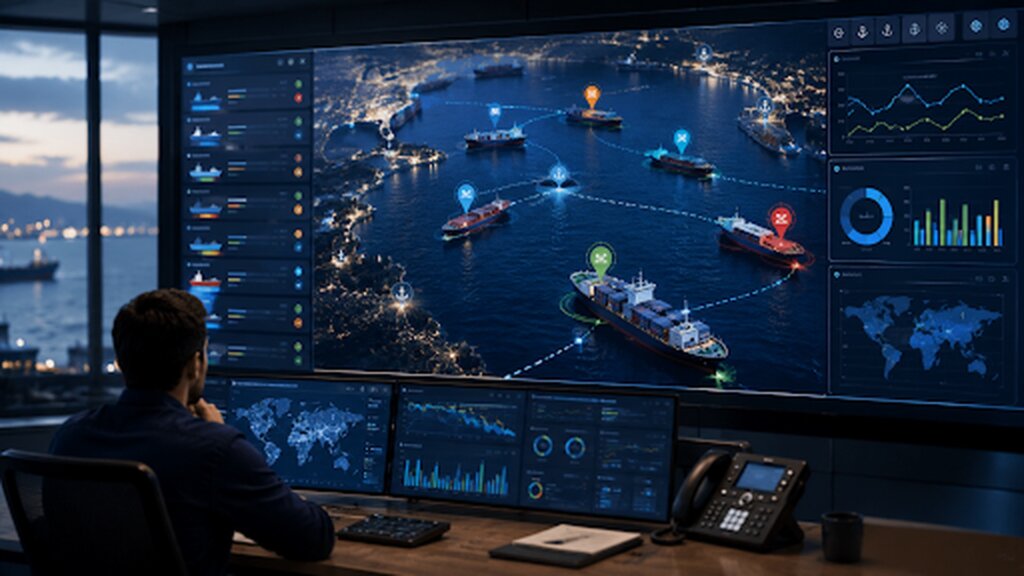
The distinction between route optimization software that plans routes and route optimization software that continuously optimizes them during execution is the most important capability gap in the current market. Static route optimization software generates an optimal plan at the start of the day and treats deviations as exceptions to be manually managed. Dynamic route optimization software maintains a continuously updated model of every vehicle’s position, load, remaining delivery windows, driver hours, and the current state of the road network, and recalculates optimal paths in response to any event that changes the optimal solution. Software at this level of capability requires a real-time data pipeline rather than a scheduled batch process.
Modern this software needs to handle dozens of simultaneous constraints that static planning tools either ignore or approximate. Vehicle weight and dimension limits that determine which roads a specific vehicle can legally use. Time window constraints for deliveries that must arrive within defined windows rather than simply as early as possible. Load capacity and sequencing constraints that determine which orders can be loaded on the same vehicle in what order. Driver hours of service limits governed by FMCSA regulations in the USA, which constrain how long a driver can operate before mandatory rest periods. Route optimization software that treats these as simple filters rather than hard constraints in a genuine optimization model produces plans that look efficient on paper.
These plans generate compliance violations and failed deliveries in practice, which is why constraint handling depth is one of the most meaningful technical differentiators between route optimization software platforms.
Building fleet management software from scratch represents a significant investment that most logistics operations don’t need to make if their workflows fit within what established platforms support. Off-shelf fleet management software handles standard GPS tracking, basic route planning, maintenance scheduling, and driver management well for operations with relatively straightforward requirements. Fleet management software development becomes the right choice when the operational workflows are genuinely distinct from what configurable platforms support: multi-depot operations with complex load optimization across hubs, integration requirements with proprietary warehouse management or order management systems that standard connectors don’t support, or regulatory environments that require documentation formats no off-shelf platform generates.
Custom development also makes sense when the organization intends to build a competitive advantage on the logistics technology itself rather than simply using technology to execute standard logistics operations. A third-party logistics provider whose differentiator is superior route optimization software and real time fleet tracking visibility for shipper clients has a business case for a custom build case that a single-brand carrier running standard operations doesn’t. ICANIO’s approach to the engagement begins by mapping which specific capabilities the organization actually needs that existing platforms don’t provide, rather than treating custom development as a default option for any organization that found the off-shelf evaluation process frustrating.
Real time fleet tracking is the foundation that every other capability in a modern fleet platform depends on, but the architecture required to deliver genuine real-time visibility at scale is more demanding than the phrase suggests. A telematics device on each vehicle generates GPS coordinates, engine diagnostics, fuel level readings, driver event data, and sensor outputs at update intervals that can range from seconds to minutes depending on configuration. Real time fleet tracking across a fleet of hundreds or thousands of vehicles means ingesting, processing, and storing millions of data points per hour, routing each to the relevant downstream systems, and surfacing meaningful operational signals without drowning fleet managers in raw telemetry.
The architecture decision that most determines whether real time fleet tracking actually performs in production is the choice between event streaming and batch processing for the vehicle data pipeline. Batch processing collects vehicle data over a time window and processes it together, which is operationally simpler and less expensive but introduces latency that makes alerts, geofence triggers, and route recalculation lag behind what’s actually happening on the road. Real time fleet tracking built on event streaming infrastructure, using platforms like Apache Kafka or cloud-native equivalents, processes each data event as it arrives and can trigger downstream responses in seconds rather than the minutes or longer that batch processing introduces.
ICANIO’s DevOps and Cloud Engineering practice designs this event streaming pipeline as the foundational layer of every real time fleet tracking engagement, since retrofitting a streaming architecture onto a system built around batch processing is one of the more costly infrastructure rework scenarios in fleet management software development.
Logistics tracking software that operates as an isolated system, collecting vehicle data and surfacing it in its own dashboard without connecting to the surrounding operational systems, delivers a fraction of its potential value. The operational decisions that fleet managers, dispatchers, and logistics coordinators need to make depend on data from multiple systems simultaneously: inventory status from the warehouse management system, order priorities from the order management system, carrier capacity from the TMS, and customer communication preferences from the CRM. Software that requires manual data transfer between these systems introduces the delays and errors that eliminate much of the efficiency that real time visibility is supposed to provide.
Logistics tracking software integration with ERP systems is one of the highest-value and highest-complexity integration requirements in fleet platform development. An ERP integration that connects logistics tracking software to the financial and inventory management systems the business already runs on enables automatic cost allocation by route and vehicle, inventory depletion triggered by confirmed deliveries, and the complete operational data needed for the transportation cost analytics that logistics finance teams need. ICANIO’s Application Development teams design these ERP integrations as first-class deliverables rather than post-deployment additions, since the data model decisions that determine integration depth need to be made during architecture design.
Building the integration after the core platform is already built forces it to adapt to schema choices made without integration requirements in mind, which typically produces a fragile connection rather than a reliable data pipeline.
Logistics tracking software increasingly needs to extend visibility beyond internal operations to external stakeholders. Shippers and consignees expect real-time delivery tracking and automated ETA notifications as standard features of any logistics provider relationship, and a platform that provides this visibility as a customer-facing portal rather than requiring customers to call a dispatcher for status updates is increasingly a commercial requirement rather than a differentiator. Building this customer visibility layer requires the the platform to expose a well-designed API or webhook system that can push status updates to customer systems and white-labeled tracking portals without requiring access to internal operational data.
Transportation management software at enterprise scale needs to connect fleet tracking and route optimization capabilities with the broader supply chain systems that govern how freight moves across a network, not just how individual vehicles execute their daily routes. Transportation management software that handles carrier selection, load tendering, freight audit, and multi-modal shipment visibility alongside internal fleet operations gives logistics operators a unified view of transportation spend and performance that siloed point solutions can’t provide. The integration between transportation management software and fleet tracking systems is what enables the shipment-level visibility that enterprise shippers and 3PLs increasingly expect from their logistics technology stack.
Transportation management software for US trucking operations must address Electronic Logging Device compliance as a core requirement rather than an optional module. ELD integration with transportation management software connects hours of service data directly into dispatch and route planning workflows, since a driver approaching their HOS limit needs to be accounted for in route assignments and delivery scheduling before that limit is reached rather than after it triggers a violation. Transportation management software that treats ELD data as a compliance reporting output rather than an operational input misses the most valuable use of hours of service data, which is constraining dispatch decisions in real time so that compliance violations don’t occur rather than documenting them after they have.
Predictive maintenance is the fleet management software development capability that consistently produces the clearest ROI signal in production deployments, because the cost of an unplanned vehicle breakdown, including recovery, repair, delayed deliveries, and secondary dispatch costs, is dramatically higher than the cost of a planned maintenance intervention triggered by early warning signals. Fleet management software development for predictive maintenance requires machine learning models trained on historical vehicle sensor data, maintenance event records, and operational patterns to identify degradation signatures that precede failures by days or weeks rather than hours.
The data infrastructure requirements for predictive maintenance in fleet management software development are more demanding than for tracking alone. Sensor data needs to be captured at sufficient resolution to detect the subtle signatures that precede component failures, stored in a format that supports time-series analysis across entire vehicle lifetimes, and processed by models that can distinguish genuine degradation patterns from normal sensor variation. AI-driven predictive maintenance in fleet operations has been shown to reduce emergency repairs by over 60%, a result that requires both the right model and the right data infrastructure rather than either alone.
ICANIO’s Data and AI service line designs this data pipeline and model architecture for these engagements that include predictive maintenance capabilities.
Fleet operations that have achieved the strongest outcomes from AI-powered logistics technology consistently follow a phased deployment path that builds capabilities progressively rather than attempting to deploy route optimization, real time fleet tracking, predictive maintenance, and transportation management software integration simultaneously. The first phase establishes reliable fleet visibility and basic route optimization software, building the data foundation and the operational trust that more advanced capabilities require. The second phase adds AI-enhanced AI-enhanced routing that learns from historical patterns to improve constraint handling and delivery window compliance. The third phase introduces predictive maintenance and driver behavior analytics that depend on the extended data history the first two phases accumulated.
This phased approach reduces deployment risk by ensuring each capability has the data foundation it needs to perform meaningfully at launch rather than requiring months of data accumulation before delivering value. Logistics tracking software and TMS integrations typically happen across the first two phases, since the operational data flows those integrations require need to be established before advanced analytics can draw on them. ICANIO’s fleet management software development practice recommends this phased architecture to clients regardless of the scope of their eventual target state, since the organizations that have deployed everything at once have consistently encountered more integration debt and organizational resistance than those that built progressively.
ICANIO’s engagements begin with an operational workflow mapping phase that identifies the specific capabilities the client’s fleet operation needs that existing tools don’t deliver, before any architecture decision is made. Clients across the USA, UK, and Malaysia have worked with ICANIO on logistics tracking software, fleet tracking platforms, and these development projects spanning last-mile delivery operations, long-haul fleet management, and multi-carrier TMS integrations.
The company’s development teams, based out of Tirunelveli with a branch office in Chennai, bring together Data and AI, Application Development, DevOps and Cloud Engineering, and MLOps capability for these engagements. ICANIO’s CMMI Level 3 certification is particularly relevant for transportation and logistics clients whose enterprise contracts and government relationships require documented process maturity from their technology development partners, since fleet management software development at enterprise scale involves the kind of complex, long-running engagement where process discipline directly affects delivery reliability.
Static route optimization software plans routes once before the day begins. Dynamic route optimization software continuously recalculates optimal routes during execution in response to real-world events including traffic changes, vehicle breakdowns, new orders, and driver hours of service limits.
Custom fleet management software development makes sense when operational workflows require multi-depot optimization, deep ERP or WMS integration, proprietary compliance documentation formats, or when the logistics technology itself is a competitive differentiator the business wants to own rather than license.
Real time fleet tracking at scale requires event streaming infrastructure that processes vehicle data as it arrives rather than in batches, enabling alerts, geofence triggers, and route recalculation to respond within seconds to changing conditions on the road.
Logistics tracking software ERP integration connects delivery confirmation, vehicle cost data, and route performance metrics directly into financial and inventory management workflows, enabling automatic cost allocation and inventory updates without manual data transfer between systems.
ELD integration connects driver hours of service data directly into dispatch and route planning workflows, allowing transportation management software to account for HOS limits when assigning routes rather than discovering violations after they have already occurred.
Quick Links
Careers
Internship
Contact Sales
© 2025
Icanio - All rights reserved.