Ecommerce platform development in 2026 forces a foundational architecture decision that most teams get wrong not because they lack information but because they’re framing the question incorrectly. The standard framing, microservices or monolith, presents a binary choice when the most successful ecommerce platform development outcomes in the past several years have come from teams that chose neither extreme. Shopify, one of the largest ecommerce platforms in the world, runs a modular monolith that handles billions in annual transactions.
Amazon, whose scale genuinely required a different approach, migrated from a monolith only after exhausting what its original architecture could do. The lesson from both is the same: the right ecommerce platform architecture is the one that matches your current scale and team size, not the one that looks most technically sophisticated.
ICANIO Technologies has worked with retail and ecommerce clients across a range of scale and complexity profiles, and the architecture conversation comes up in every engagement. This piece walks through what the ecommerce microservices vs monolith decision actually involves, where scalable ecommerce architecture starts to require a distributed approach, how headless commerce development fits into the picture, and what the realistic migration path looks like for platforms that start with a simpler structure and need to evolve.
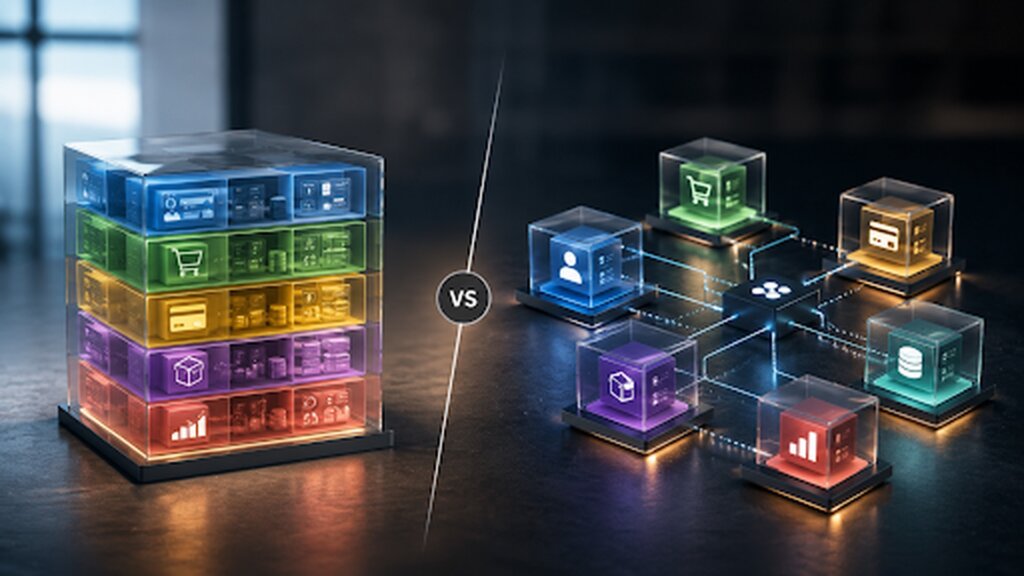
The most useful way to approach the platform architecture is not a comparison of technical properties but a set of four practical questions that, answered honestly for a specific context, point clearly toward the right starting architecture. Ecommerce platform development teams that skip this framing and go straight to technology selection tend to over-engineer early products and under-engineer the parts that actually limit scale later.
The first question is team size. Ecommerce platform development for a team of fewer than twenty engineers rarely benefits from microservices architecture, since the coordination overhead of managing independent services, their separate deployment pipelines, distributed tracing, and service-to-service authentication, consumes more engineering capacity than the scalability benefits return. The second question is transaction volume.
Ecommerce platform development that targets more than a million requests per day may genuinely need components that can scale independently, since a single deployment unit that must scale as a whole cannot optimize resources for the specific bottlenecks that emerge at high volume. The third question is team structure. Microservices architecture ecommerce deployments work best when the organization has fully independent teams owning separate services, which is Conway’s Law in practice, since distributed systems and distributed teams reinforce each other. The fourth question is product maturity. Ecommerce platform development on a product whose requirements are still evolving benefits from the faster iteration and simpler debugging of a well-organized monolith.
The ecommerce microservices vs monolith debate has reached a more nuanced conclusion in 2026 than the microservices-first narrative that dominated the previous several years. The ecommerce microservices vs monolith question is no longer answered by pointing at Netflix as proof that microservices are the inevitable destination of any serious platform. Netflix’s architecture requires hundreds of engineers dedicated solely to the infrastructure that supports it, which is an investment most ecommerce organizations cannot make and don’t need to.
A 2026 survey found that approximately 60% of early-stage ecommerce startups continue to use monolithic architectures for their first twelve to eighteen months, which reflects a hard-won industry recognition that the ecommerce microservices vs monolith choice needs to match actual scale rather than anticipated scale. The ecommerce microservices vs monolith conversation has also shifted because premature microservices adoption has caused as many project failures as premature scaling assumptions.
The ecommerce microservices vs monolith conversation is also complicated by the rise of the modular monolith as a recognized, legitimate architectural pattern rather than a compromise position. A modular monolith structures a single deployment unit with clear internal boundaries between domains, essentially giving teams the organizational clarity of separated concerns without the operational overhead of distributed services. ICANIO’s Application Development practice treats the modular monolith as the default recommendation for ecommerce platform development teams that haven’t hit the scaling thresholds that genuinely require independent service deployment.
Microservices architecture ecommerce deployments deliver their genuine advantages in specific, well-defined scenarios. High-volume ecommerce platforms where different components have dramatically different scaling requirements are the clearest case for this distributed design: a search service that needs to handle thousands of concurrent queries during a flash sale requires very different infrastructure from the order management service processing a fraction of that volume. Microservices architecture ecommerce systems allow each of these components to scale independently rather than requiring the entire platform to scale uniformly to accommodate the most demanding component.
Microservices architecture ecommerce platforms typically decompose along business capability boundaries: product catalog, inventory management, cart and checkout, order processing, payment, search, recommendations, customer accounts, and shipping and logistics. Each service in a microservices architecture ecommerce deployment owns its own data, deploys independently, and communicates with other services through well-defined APIs or event streams. This ownership model is what makes microservices architecture ecommerce systems resilient to individual service failures: a bug in the recommendations service doesn’t bring down the checkout flow the way it would in a tightly coupled monolith where all components share a single process.
The operational requirements that microservices architecture ecommerce platforms introduce are significant and shouldn’t be underestimated. Distributed tracing, service mesh for inter-service communication, independent deployment pipelines for each service, and centralized logging across dozens of services all require engineering investment that a well-organized monolith doesn’t need. ICANIO’s DevOps and Cloud Engineering practice builds this operational infrastructure as a foundational deliverable in these engagements, recognizing that a microservices system without adequate observability is considerably harder to operate and debug than the monolith it was meant to improve on.
Scalable ecommerce architecture doesn’t require microservices. Shopify’s scalable ecommerce architecture, which is built on a modular Ruby on Rails monolith, handles millions of merchants and billions in transactions annually, demonstrating that scalable ecommerce architecture at genuinely enterprise scale is achievable without a distributed system, provided the internal architecture is disciplined. The key to scalable architecture in a monolithic deployment is treating module boundaries with the same rigor that microservices teams apply to service boundaries: clear interfaces between domains, no direct cross-module database queries, and deliberate dependency management that prevents the module boundaries from eroding over time as the codebase grows.
Scalable ecommerce architecture at high volume typically requires database strategies that go beyond a single relational database regardless of whether the application architecture is monolithic or microservices-based. Read replicas distribute query load for catalog and product pages that serve far more reads than writes. Caching layers reduce database hits for frequently accessed, slowly-changing data like product listings and category pages.
Event sourcing patterns can separate the write path from the read path for order processing, allowing the scalable ecommerce architecture to optimize each independently. ICANIO’s Data and AI service line works alongside Application Development on these these database strategies, since the data architecture decisions have as much impact on platform performance under load as the application architecture choices they support.
Headless commerce development sits alongside but is distinct from the microservices vs monolith decision, though the two often get conflated. Headless commerce development decouples the frontend presentation layer from the backend commerce engine, allowing the user-facing storefront to be built independently from the underlying product, inventory, and order management systems. Headless commerce development doesn’t require microservices architecture in the backend: a well-built monolithic commerce engine with a clean API layer can support headless architectures just as effectively as a distributed backend, provided the API contracts are designed with that decoupled consumption in mind.
Headless commerce development makes the strongest business case when an organization needs to serve customers across multiple touchpoints simultaneously, a web storefront, a mobile app, a voice interface, an in-store kiosk, that all need to pull from the same commerce data through a consistent API layer. Headless commerce development also makes sense when the frontend iteration pace needs to be faster than the backend release cycle allows in a tightly coupled traditional commerce system. The investment headless architecture requires, in API design, frontend infrastructure, and the operational complexity of managing separately deployed frontend and backend systems, is only justified when these specific needs exist.
ICANIO’s these headless engagements typically use API-first backend design regardless of whether the initial frontend is headless or traditional, since designing commerce APIs with headless consumption in mind from the start avoids the rework required to support a headless frontend added later to a backend that wasn’t designed for it. This approach keeps headless as a realistic evolution path even for teams that start with a coupled frontend, rather than committing the full headless infrastructure investment before the business case is proven.
Most successful ecommerce platform development journeys follow a pattern that post-facto microservices advocacy often obscures: start with a monolith, grow it until specific scaling bottlenecks emerge, and then extract the services that actually need independent scaling rather than decomposing the entire platform at once. Amazon followed this path. The incremental extraction approach, sometimes called the Strangler Fig Pattern, allows an ecommerce platform development team to migrate toward microservices architecture ecommerce in a way that delivers value at each step rather than requiring a complete rewrite before any benefit is realized.
The services that most commonly get extracted first in these platform migrations are the ones with the highest and most variable traffic: search, product catalog display, and recommendations are frequent early candidates because they serve enormously more read traffic than write traffic and can be independently cached and scaled. Payment processing is often extracted early not for scale reasons but for security isolation, since keeping payment flows in their own service with its own deployment pipeline and access controls reduces PCI DSS scope and simplifies compliance auditing across the rest of the ecommerce platform development architecture.
Peak traffic events, flash sales, promotional launches, and seasonal spikes represent the scenario where the ecommerce microservices vs monolith decision has the most visible operational consequences. A monolithic ecommerce platform scales by adding more instances of the entire application, which works well when the bottleneck is evenly distributed across the platform but wastes resources when only specific components are under stress. A a distributed platform can scale the catalog and search services that are under load during a browse-heavy event independently from the checkout and payment services that only come under pressure when purchases complete.
The ecommerce microservices vs monolith performance trade-off also runs in the other direction that most discussions miss. Monolithic applications benefit from in-process communication between components that takes microseconds, while microservices architecture ecommerce systems pay a network round-trip overhead for every inter-service call. For latency-sensitive operations like cart updates and checkout validation that chain multiple operations together, this network overhead accumulates in ways that require careful architectural design to manage. ICANIO’s DevOps and Cloud Engineering practice designs for this latency profile from the start of microservices architecture ecommerce engagements, using service co-location, caching, and asynchronous processing patterns to keep checkout and purchase flows fast even when the underlying scalable ecommerce architecture is distributed.
Scalable ecommerce architecture at production scale requires observability infrastructure that allows engineering teams to understand what the system is doing under real load, not just whether it’s up or down. Distributed tracing that follows a customer request through every service it touches, centralized logging that aggregates output from every component into a queryable stream, and metrics dashboards that surface latency, error rates, and throughput per service are all prerequisites for operating a scalable ecommerce architecture reliably rather than reactively. For headless deployments specifically, where frontend and backend are separately deployed, observability needs to span both layers and correlate user-facing performance metrics with the backend API performance that drives them.
ICANIO’s this engagements start with an architecture scoping phase that maps the current and near-term scale requirements, team structure, and product maturity before any architecture decision is made. Clients across the USA, UK, Australia, and Malaysia have worked with ICANIO on ecommerce platform development projects spanning initial platform architecture design, microservices architecture ecommerce decomposition of existing platforms, and headless commerce development for multi-channel retail and D2C contexts.
The company’s development teams, based out of Tirunelveli with a branch office in Chennai, bring together Application Development, Data and AI, DevOps and Cloud Engineering, and MLOps capability for these engagements. The DevOps and Cloud Engineering practice is particularly central to these distributed and headless development work, since both architectural patterns require significantly more infrastructure investment than a well-structured monolith, and that infrastructure needs to be built for the these architecture requirements from day one rather than added after performance problems emerge in production.
When different components have dramatically different scaling requirements, when the organization has fifty or more engineers who need to work independently, or when product maturity has reached the point where specific scaling bottlenecks make independent service deployment genuinely valuable rather than speculative.
Yes. Shopify’s modular monolith architecture handles billions in annual transactions, demonstrating that a robust architecture doesn’t require microservices when the internal module boundaries are disciplined and the database strategy is designed for high-volume read traffic.
A modular monolith is a single deployment unit with clear internal boundaries between business domains, offering the organizational clarity of separated concerns without the operational overhead of distributed microservices. It is increasingly recognized as the right default for most projects that haven’t hit genuine microservices scaling thresholds.
No. Headless commerce development decouples the frontend from the backend through a clean API layer, which a well-built monolithic backend can support as effectively as a distributed one, provided the API contracts are designed with headless consumption in mind from the start.
ICANIO treats the ecommerce microservices vs monolith decision as a function of team size, transaction volume, product maturity, and organizational structure rather than a default recommendation, recommending the modular monolith as the starting point for most ecommerce platform development projects and microservices extraction when specific scaling needs justify the operational investment.
Quick Links
Careers
Internship
Contact Sales
© 2025
Icanio - All rights reserved.